Tennessee Dog Laws: Do You Need a Fence for Your Dog?
No Tennessee law requires a fence for your dog, but you must keep it from running at large. Under Tenn. Code Ann. § 44-8-408, a dog loose on a road or a neighbor's property is at least a Class C misdemeanor, and a dog "securely confined in a kennel, crate or other enclosure" is a listed exception.
Loudon County Fence is a veteran-owned fence contractor that has built fences across East Tennessee since 1973, and dog containment is one of the most common reasons people call us. This guide walks through what the Tennessee statutes actually say, how Knoxville's tethering rule works, and how to build a fence that holds a determined dog on East Tennessee ground.
Is there a Tennessee law that requires a fence for dogs?
No. Tennessee does not tell you how to contain your dog. It tells you what happens if you don't.
The key civil statute, Tenn. Code Ann. § 44-8-413, puts the duty plainly: "The owner of a dog has a duty to keep that dog under reasonable control at all times, and to keep that dog from running at large." The criminal statute, Tenn. Code Ann. § 44-8-408, makes it an offense when a dog "goes uncontrolled by the owner upon the premises of another without the consent of the owner of the premises" or "upon a highway, public road, street or any other place open to the public generally."
Neither statute says the words "you must build a fence." A leash, a kennel, a crate or staying outside with your dog can all satisfy the duty. But if your dog spends unsupervised time in the yard, a physical enclosure is the only practical way to make sure it never ends up in the road or in the neighbor's garden. That is why the question we hear is almost never "do I have to" and almost always "what fence will actually hold my dog."
What does "running at large" mean in Tennessee?
It means your dog is loose and uncontrolled somewhere it has no right to be: someone else's property without permission, or any public place.
The definition is in § 44-8-413(e)(2): "'Running at large' means a dog goes uncontrolled by the dog's owner upon the premises of another without the consent of the owner of the premises, or other person authorized to give consent, or goes uncontrolled by the owner upon a highway, public road, street or any other place open to the public generally."
Two practical takeaways from that wording:
- Your own yard is not "running at large." A dog loose on your own property is not covered by the definition. The problem starts the moment it crosses your line.
- An unfenced front yard is risky. Most East Tennessee front yards run straight to the street or a sidewalk. A dog that chases a car one step past your property line is on a "public road" under the statute.
The "owner" is defined as the person who "regularly harbors, keeps or exercises control over the dog." A friend dog-sitting for a weekend is generally not the owner under § 44-8-408(a), which excludes a person "temporarily harboring, keeping or exercising control over the dog."
What is the penalty if my dog gets out?
The base offense is a fine-only Class C misdemeanor. The penalty climbs with the harm the dog causes.
Here is how § 44-8-408(g) grades a violation for an ordinary dog with no history:
| What happened while the dog was loose | Offense class under § 44-8-408(g) |
|---|---|
| Dog ran at large, no damage or injury | Class C misdemeanor, fine only |
| Dog damaged someone else's property | Class B misdemeanor, fine only |
| Dog caused bodily injury to a person | Class A misdemeanor, fine only |
| Dog caused serious bodily injury | Class E felony |
| Dog caused a death | Class D felony |
Harsher penalty levels apply under § 44-8-408(h) and (i) if the dog was trained to fight or the owner knew the dog had already caused serious injury. A court must also order "full restitution for all damages" when a loose dog injures someone or damages property, under § 44-8-408(k)(1).
Here is the part most owners miss, and the reason fence quality matters. Subsection (e) says: "It is not a defense to prosecution for a violation of subsection (b) and punished pursuant to subdivision (g)(1), (g)(2) or (g)(3) that the dog owner exercised reasonable care in attempting to confine or control the dog." In plain English, for the three misdemeanor levels, "I had a fence and he dug under it" is not a defense. Reasonable care is only an affirmative defense at the felony levels, under subsection (f). A fence that almost holds your dog does not protect you. It has to actually hold.
Does a fence protect me if my dog bites someone?
It helps in two specific ways. A securely confined dog is an exception to civil liability, and a bite on your own residential property is harder for a claimant to win.
The general rule in § 44-8-413(a)(2) is strict: an owner who lets a dog run at large "may be held liable regardless of whether the dog has shown any dangerous propensities." But § 44-8-413(b) lists exceptions, including when "The injury occurred while the dog was securely confined in a kennel, crate or other enclosure."
Separately, § 44-8-413(c)(1) changes the rules on your own home ground. If a dog injures someone "on residential, farm or other noncommercial property" and the dog's owner owns the property or is there with permission or as a lawful tenant, "the claimant shall be required to establish that the dog's owner knew or should have known of the dog's dangerous propensities." That is a meaningfully higher bar than the strict rule that applies when a dog is loose in public.
Put those together and the picture is simple: the law treats a dog kept home and confined very differently from a dog that got out. We are a fence contractor, not a law firm, so if a bite or injury claim is already in play, talk to a Tennessee attorney. The time limit to sue under § 44-8-413(d) is the same one used for personal injury actions under § 28-3-104.
Can you chain or tether a dog outside in Knoxville?
Only while a responsible person is outside with the dog. Inside Knoxville city limits, unsupervised tethering is not allowed.
Knoxville City Council approved Ordinance O-19-2023, "An Ordinance to amend the Knoxville City Code, Chapter 5, to establish additional minimum requirements for the care and keeping of animals," on second reading on January 24, 2023, by an 8-1 vote, according to the official City Council legislative record. The amendments adopted that night set two rules worth knowing:
- Supervision: "The responsible and competent person is outside with the animal." A proposal to also allow the person to be inside for up to 15 minutes failed on a 4-4 vote.
- Tether length: "The tether at least five (5) times the length of the animal's body as measured from the tip of the nose to the base of the tail or a minimum of ten (10) feet, whichever is longer."
For a Knoxville household where the dog is outside while everyone is at work, that ordinance effectively takes the chain off the table. The realistic options are a fenced yard or a dedicated kennel run. This rule is a City of Knoxville rule. If you live in unincorporated Knox County, Farragut or another town, check with that local government, because animal rules differ by jurisdiction.
Does an invisible or electric dog fence count?
The statutes do not say. Neither § 44-8-408 nor § 44-8-413 defines "enclosure," and we are not aware of a Tennessee statute that addresses buried-wire systems directly.
What we can tell you from the field is practical, not legal. An electronic collar system keeps your dog in only as long as the battery is charged, the wire is intact and the dog decides the shock is not worth it. It does nothing to keep other dogs, kids or wildlife out. Buried wire is also easy to cut with a post-hole digger or an edger, and it has to be marked like any other buried line before anyone digs. If the goal is to meet a legal duty that does not accept "I tried" as a defense at the misdemeanor level, a physical barrier is the safer bet. Some HOAs restrict physical fences, which is one reason owners look at invisible systems, so read your covenants either way. Our guide on whether your HOA has to approve your fence in Knox County covers that process.
What fence works best for dogs, and what does it cost?
The best dog fence is the one your particular dog cannot climb, jump or dig under. Height and the bottom edge matter more than the material.
| Fence type | Installed price range (per foot) | Dog containment notes |
|---|---|---|
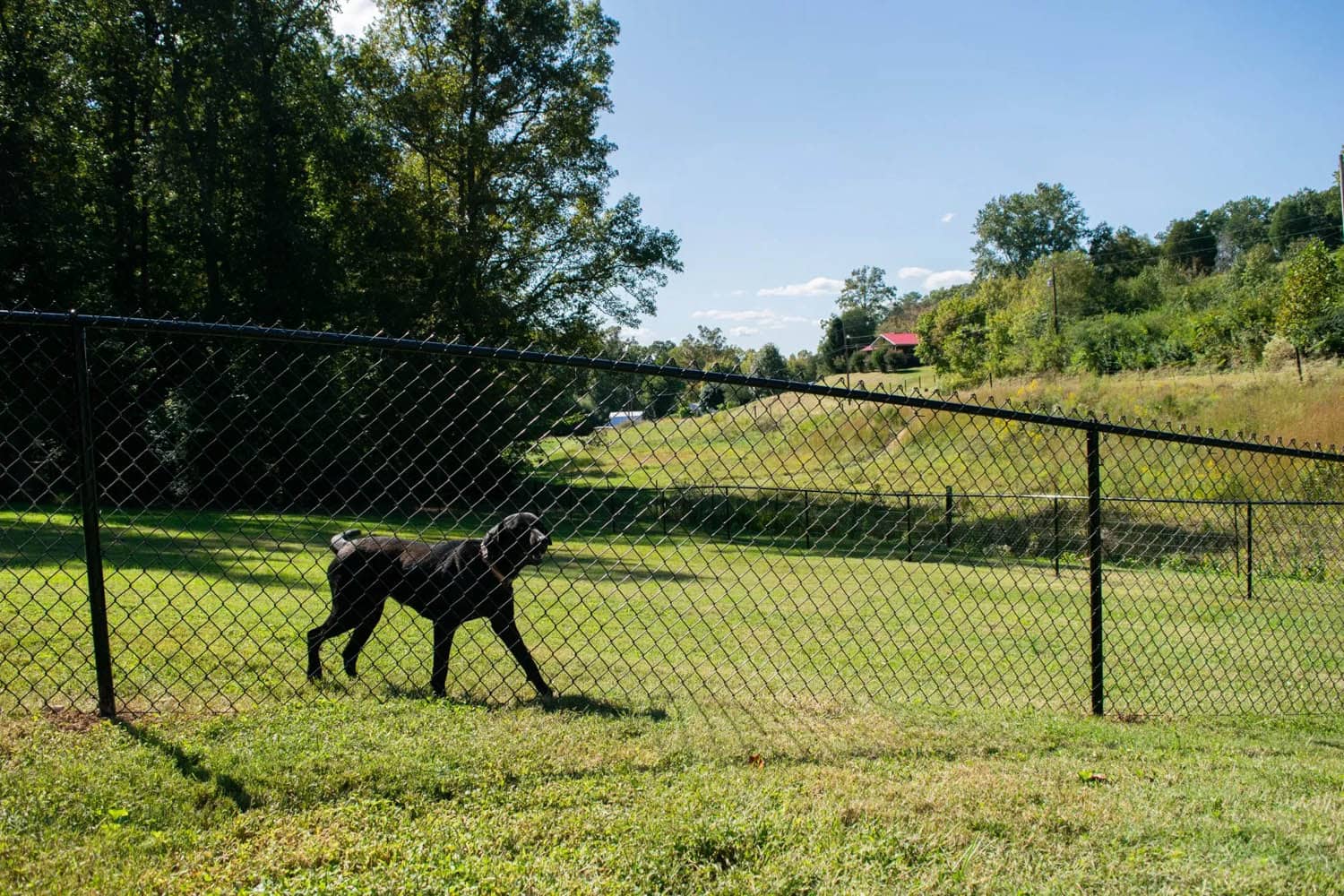
| Chain link | $10-40 | Most affordable full enclosure. Some dogs climb the diamond mesh. Black coating blends into a tree line. |
| Wood privacy | $14-50 | Blocks the view that triggers fence-running and barking. Keep horizontal rails on the outside so climbers have no foothold. |
| Vinyl privacy | $19-60 | Smooth face with nothing to grip. Popular in HOA neighborhoods. |
| Ornamental aluminum | $24-70 | Vertical pickets, no footholds, keeps the view. Confirm picket spacing works for small dogs. |
As a rule of thumb, 4 feet holds most small and medium dogs, and athletic breeds such as shepherds, huskies and labs usually need 6 feet. For more on picking height and material by breed, see our dog-friendly fence guide. Real prices depend on length, slope, gates and site access, which is why we price on site. Our fence cost page explains what moves the number.
How do you build a dog fence that holds on East Tennessee ground?
Close every gap at the bottom, put the gate on a self-closing hinge, and plan for the slope. Most escapes we get called about are under the fence or through the gate, not over the top.
- Call Tennessee 811 first. Tennessee requires notice at least 3 working days before you dig. Utility lines run through a lot of backyards here. Our post on calling 811 before digging fence posts has the details.
- Check height rules before you pick a height. In the City of Knoxville, a privacy fence is limited to 42 inches in front of a line 5 feet behind the front building line (Zoning Code Art. 10, Sec. 10.3.L). In unincorporated Knox County, front-yard fences that block vision are limited above 3.5 feet (Sec. 3.20.04.B). Farragut exempts fences up to 7 feet from building permits. Most dog fences go in the backyard, where these front-yard limits do not apply.
- Rack the fence to the grade. East Tennessee lots are rarely flat. A fence that steps down a hill leaves triangle-shaped gaps under each section, and a small dog will find every one. Racking the panels or mesh to follow the ground closes those gaps.
- Close the bottom for diggers. Add a bottom rail, a kickboard, or bury wire or a concrete mow strip along the line. Our red clay holds a dog's tunnel well, which works against you here.
- Set posts for clay and rock. Clay that heaves and shrinks with the seasons loosens shallow posts, and a leaning post opens a gap. We set posts to depth and adjust for the limestone ledge that shows up across much of the valley.
- Get the gate right. Use a self-closing hinge, a latch the dog cannot nose open, and a small gap under the gate. Put the latch high enough that a visiting child cannot casually open it.
- Walk the line after storms. A fallen limb that bends a section or a washout under a run is the most common way a fence that held for years suddenly does not.
Who do you call about a loose dog in Knox County?
Young-Williams Animal Center's Animal Services division. The Knox County Sheriff's Office animal control page states that animal control is now "Animal Services" a division of Young Williams Animal Center, reachable at (865) 407-2229, and that it handles "animals at large, animal welfare, minor animal bites, and nuisance animals."
If a neighbor's dog keeps getting into your yard, document each time with photos and dates before you call. And if the loose dog is yours, fixing the weak spot in the fence is cheaper than any of the outcomes in the penalty table above.
Key facts
- No Tennessee statute requires a fence for dogs, but Tenn. Code Ann. § 44-8-413(a)(1) requires owners to keep dogs under reasonable control and from running at large.
- A dog running at large is a Class C misdemeanor under § 44-8-408(g)(1), rising to a felony if the dog causes serious bodily injury or death.
- For the misdemeanor levels, reasonable care in trying to confine the dog is not a defense under § 44-8-408(e).
- A dog "securely confined in a kennel, crate or other enclosure" is an exception to civil liability under § 44-8-413(b)(4).
- Knoxville Ordinance O-19-2023 requires a responsible person to be outside with a tethered animal and a tether at least 5 times the animal's body length or 10 feet, whichever is longer.
- In Knox County, loose-animal calls go to Young-Williams Animal Center's Animal Services at (865) 407-2229.
This article reflects the Tennessee Code and the City of Knoxville legislative record as published in November 2026. It is general information, not legal advice. For an injury or liability question, talk to a Tennessee attorney, and confirm local animal rules with your city or county.
Need a fence that actually holds your dog?
We will walk your yard, look at the slope, the soil and how your dog behaves, and give you a written price for a fence built to hold. Call Loudon County Fence at (865) 988-9935 or request a free on-site estimate. More answers to common questions are on our fence answers page.