Fence Installation in Knoxville, TN
Loudon County Fence has been building fence across Knox County since 1973 — wood privacy, vinyl, chain link, ornamental aluminum and farm fence. Veteran-owned, Tennessee Unlimited License #54371, bonded to $6M. What follows is what we have learned about building fence on Knoxville ground specifically: what the rock and clay do to a post, what the work actually costs here, and what the city and county ordinances really say. Free on-site estimate: (865) 988-9935.
Knoxville ground is the reason two identical yards get different fence quotes
Knoxville sits in the Valley and Ridge province — folded, faulted sedimentary rock over classic karst terrain. Knox County has enough sinkhole activity that the USGS published a dedicated map sheet for it. What that means on a job site is that the auger stops when it stops, and where it stops depends entirely on which soil series your lot happens to sit on.
| Soil series | Depth to bedrock | What it means for your posts |
|---|---|---|
| Montevallo | 7 to 20 inches | The auger refuses almost immediately. Rock drilling or a rock-anchored detail is required. |
| Apison | 20 to 40 inches | Gravelly. A standard 24-inch hole is possible but not guaranteed. |
| Corryton | More than 60 inches | Normal digging. Shrink-swell clay is the concern here, not rock. |
Those figures come from the NRCS Soil Survey of Knox County. Dewey, Fullerton, Townley and Heiskell series are also common across the county. Two neighbors on the same street can sit on different series, which is why we will not quote a Knoxville fence off satellite imagery.
Frost depth is not what sets post depth here
Knox County's adopted frost line is 12 inches, per Table R301.2(1) in the county's amendments to the 2018 IRC. That surprises people who moved here from the Midwest. Twelve inches is shallow, and it is not what drives the design.
What drives it is overturning load and clay movement. A solid six-foot privacy fence is a sail, and the county's adopted design wind value in that same table is 90. We bury roughly a third of the post length, which puts a six-foot fence at 24 to 36 inches depending on panel style and exposure — and on a Montevallo lot, the depth the wind load asks for and the depth the ground allows are not the same number.
What the clay does
Surface layers here run 7 to 27 percent clay; subsoil runs 35 to 60 percent. A post hole dug into that subsoil is effectively a bucket, and Knoxville averages 51.93 inches of rain a year — more than Seattle. Water standing against a post is the dominant rot mechanism in this market. Gravel at the base and a crowned concrete collar that sheds water away from the post matter more here than they would in a drier climate.
The other half is movement. Corryton and Townley soils carry moderate shrink-swell, so the ground itself shifts between a wet spring and a dry fall. That is usually what is happening when a gate that latched perfectly in April drags in September. It is rarely the hardware.
What a fence costs in Knoxville
Installed ranges for Knox County work, materials and labor together:
| Fence type | Installed, per foot |
|---|---|
| Chain link | $10 – $40 |
| Wood privacy | $14 – $50 |
| Vinyl | $19 – $60 |
| Ornamental aluminum | $24 – $70 |
The spread inside each range is mostly grade, terrain and rock. A flat quarter-acre in Halls and a sloped lot on a Montevallo ridge in West Knox are not the same job even with identical material.
A note on cedar: we do not carry it. It can be sourced by request, but it is expensive here and does not hold up well in East Tennessee clay without special installation. Ground-contact-rated pressure-treated pine is what we recommend and what we build with.
Knoxville fence rules — and the number almost everyone gets wrong
The City of Knoxville Zoning Ordinance, Article 10, § 10.3.L reads:
"From five feet behind the front building line forward to the front lot line and in the corner side yard, privacy fences and walls are limited to 42 inches. Open fences do not have a limit. There is no limit on the height of privacy fences, walls, or open fences in other yards. Fences may be constructed at the boundaries of a lot without setback with the exception of the required visibility triangle."
Three things in there that national permit-lookup sites consistently miss:
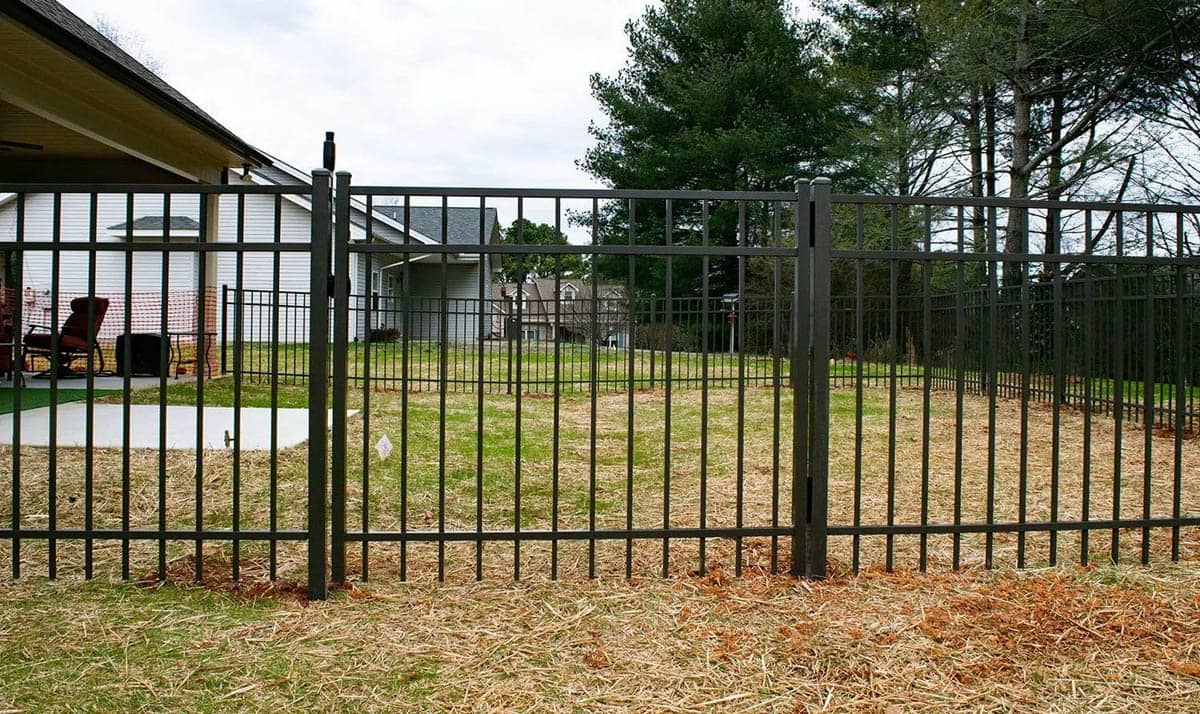
- The limit is 42 inches, not 4 feet, and it applies only to privacy fences. An open fence — picket, ornamental aluminum, anything you can see through — has no front-yard height limit at all.
- The measuring datum is five feet behind the front building line, not the front lot line.
- There is no zoning height cap in side and rear yards. The commonly repeated "6 foot maximum" is not in Knoxville's code.
Worth stating plainly: searching "Knoxville fence ordinance" will surface the code for Knoxville, Iowa — 4 feet front, 7 feet side and rear, finished side out. Those numbers are wrong for Tennessee, and they have been copied onto several contractor blogs.
Unincorporated Knox County is a different rule set
If your address is in unincorporated Knox County, the City ordinance does not apply to you. The county zoning ordinance contains no fence height limit. What it has instead is § 3.20.04, a vision rule: no fence, wall, hedge or yard ornament may materially impede vision across a front yard above 3½ feet. The practical effect is a 42-inch front-yard limit arrived at from a completely different direction.
On permits, Knox County amended IRC § R105.2 to exempt "Fences" from building permit — and the county's amendment drops the base code's "not over 7 feet high" qualifier.
Your HOA can be stricter than any of this
Every rule above is a government rule. An HOA covenant is a private contract that runs with the land, and Tennessee has no statewide act that overrides subdivision covenants for single-family homes. A 7-foot privacy fence in a Knoxville rear yard is fine under zoning and can still violate your covenants. In West Knox, Farragut and Hardin Valley subdivisions, the Architectural Review Committee is usually the binding constraint, not the city.
Before anyone digs: Tennessee 811
Tennessee's Underground Utility Damage Prevention Act requires 3 working days' notice before excavation. The ticket is good for 15 days, and the tolerance zone around a marked line is at least 4 feet wide. Penalties run to $2,500 per incident for a repeat violation and $5,000 for gross negligence — and the repair bill for a cut fiber or gas line is separate from the penalty, and usually much larger.
There is a fence-post exemption in the statute, and on a typical Knoxville subdivision lot it almost never applies: it only covers digging outside any recorded easement and more than 100 feet from the pavement edge. Most platted subdivisions carry recorded easements along exactly the rear and side lot lines where fences go.
The obligation falls on whoever is doing the excavating. If you hire us, that is us. "Did you call 811, and what's the ticket number?" is a fair question to ask any contractor before work starts.
Where we work in Knox County
We are based in Lenoir City and have been building fence across East Tennessee since 1973. Knox County neighborhoods we work in regularly:
- Farragut
- Hardin Valley
- West Knoxville
- Bearden
- Sequoyah Hills
- Concord
- Karns
- Powell
- Halls
- Fountain City
- North Knoxville
- South Knoxville
- Corryton
- Mascot
- Strawberry Plains
Beyond Knox County we cover Loudon, Blount, Anderson, Roane, Monroe, McMinn and Sevier counties.
Four questions worth asking any Knoxville fence contractor
- What happens to my price if you hit rock — is that in the quote, or is it a change order?
- What depth are you setting line posts, and gate posts?
- Is the below-grade material ground-contact rated? Above-ground-rated lumber set in a wet clay hole fails early, and it looks identical to the correct product on the day it goes in.
- Are you putting gravel under the post, and are you crowning the concrete?
A contractor who has built in Knox County can answer all four without hesitating. One who quotes a flat per-foot price sight-unseen either has not hit our rock yet, or has padded the number to cover it.
Go deeper
- Why fence posts are hard to set in East Tennessee
- Fence height and permit rules by city in East Tennessee
- Who pays for a fence between neighbors in Tennessee?
- Do you have to call 811 before digging fence posts?
- All 28 fence answers
Ordinance citations verified September 2026 against the City of Knoxville Zoning Ordinance, the Knox County Zoning Ordinance, Knox County's IRC amendments, the NRCS Soil Survey of Knox County, and NOAA climate normals for Knoxville (TYS), 1991–2020. Confirm current requirements with the jurisdiction that governs your address before you build.
FREE FENCE QUOTES
Ready to take the first step towards securing your property and enhancing its curb appeal? Requesting a quote on fencing from LC Fence is simple.