Farm, Pasture & Agricultural Fencing in East Tennessee
For over 50 years, Loudon County Fence, LLC has been the trusted choice for agricultural and farm fencing in Knoxville, TN, and across East Tennessee. Our experienced team provides durable, customizable farm fencing solutions designed to protect livestock, define property boundaries, and improve the functionality of your agricultural property. We offer a wide range of farm fencing options, including wood, vinyl, and wire mesh, each tailored to meet your specific needs and budget. Built to withstand the challenges of rural life, our high-quality fences deliver reliable protection and peace of mind for farmers and property owners. At Loudon County Fence, superior craftsmanship and customer satisfaction are our top priorities. Whether securing livestock, creating safe pastures, or enhancing the efficiency of your farm, our fencing solutions provide unmatched durability, strength, and long-term value. Contact us today to explore the best farm fencing options for your Knoxville property.
Agricultural & Farm Fencing Types




FREE FENCE QUOTES
Ready to take the first step towards securing your property and enhancing its curb appeal? Requesting a quote on fencing from LC Fence is simple.
[ Quotes Provided Within 24 Hours of Appointment 👍🏼 ]
What We Build for Farms, Pasture and Acreage
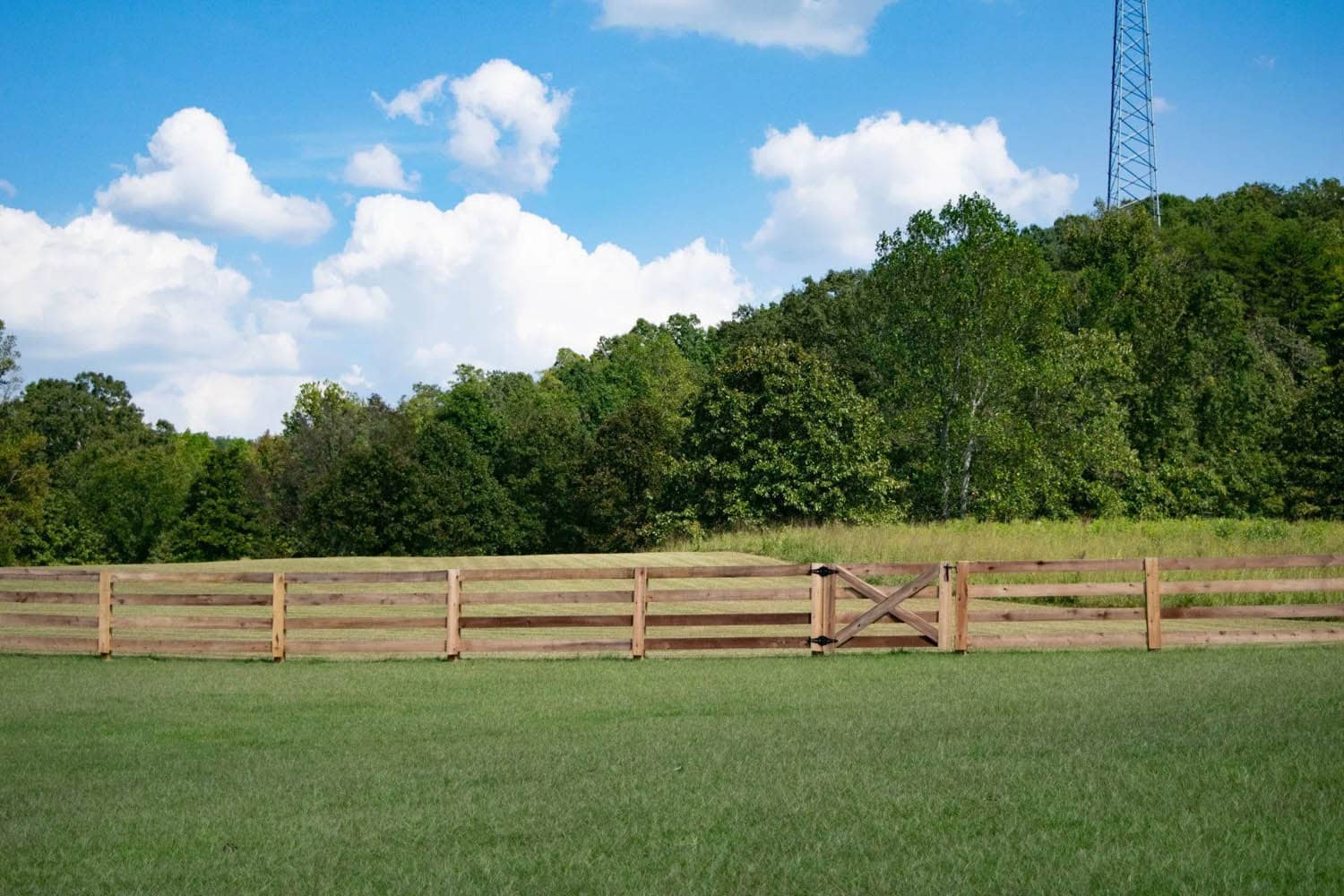
We have fenced pasture, paddock and boundary line across Knox, Loudon, Roane, Anderson, Blount, Monroe, McMinn, Rhea and Meigs counties since 1973. Gates sized for equipment, cross-fencing for rotational grazing, and repairs to fence that storms or fallen timber have taken out.
LIVESTOCK CONTAINMENT
CORNERS, BRACES AND TENSION
COST PER FOOT ON ACREAGE
Farm & Ranch Fence Questions
Livestock, long runs and the bracing that decides whether a farm fence holds.
How much does farm fence cost per foot?
Roughly $12 to $30 per linear foot installed, depending on type, terrain and gates. Across acreage that compounds fast — an acre enclosed on four sides is about 835 feet if square, so layout decisions matter more than they do on a town lot. Full cost breakdown.
What fence is best for cattle?
Woven wire and board fence are the standard answers, with high-tensile on larger tracts. Cattle push and lean, so the fence has to resist pressure rather than just mark a line.
What fence is best for horses?
Board fence or a smooth wire system rather than barbed. Horses lean and push, and barbed wire causes injuries that cattle generally avoid. Visibility matters too — horses need to see the fence, which is why board and coated high-tensile suit them.
Why does bracing matter more than the wire?
Because the wire is rarely what fails. Corner and gate bracing determines whether a farm fence holds — every run pulls against its corners, and a weak corner takes the whole line out of alignment within a season. On long runs, that is expensive to correct.
How deep do farm fence posts need to be?
Deeper than most people expect in East Tennessee clay, and corner and gate posts deeper still because everything pulls against them. Clay swells wet and shrinks dry, which is what works a shallow post loose. Why depth and drainage decide it.
Who is responsible for a fence between two farms?
A boundary fence is a partition fence under Tennessee Code 44-8-202, and adjoining owners generally share the cost of building and repairing it. Where one property is agricultural and the other is not, the non-agricultural owner may file a written disclaimer of responsibility. Full explanation.
What if neighbors cannot agree on repair costs?
Tennessee provides an out-of-court process. Either party may ask a judge of the court of general sessions to intervene, and the judge appoints three disinterested freeholders to examine the fence and determine what is owed. It exists to keep these disputes cheap to settle.
How do I handle a fence line through woods?
Clear the line first and establish the boundary before setting anything. Tennessee has no statute that draws your line — the deed and county plat govern, and a fence left in the wrong place long enough can affect where the legal line runs. On wooded tracts a survey usually costs less than moving fence.
Do I need to call 811 on farm ground?
Yes — post holes count as excavation under Tennessee law, and the locate takes about three business days. Critically, private lines are never marked: runs to barns, wells, pumps and septic fields are common on acreage and invisible to the locate. Point them out before the crew starts. Full 811 guide.
Does slope and rock change a farm fence job?
Considerably. Sloped runs must be stepped or racked to follow grade, commonly adding 10 to 25 percent to installed cost. Shallow rock means post holes that will not simply auger — and the shortcut of setting a post shallower is exactly what causes leaning a few seasons later.
General information current as of 2026, including Tennessee Code Title 44 Chapter 8 on partition fences. Not legal advice. Call (865) 988-9935 or request a free quote.
Acreage, Liability & Livestock Law
The questions that come up on working ground rather than in a subdivision.
How much does it cost to fence an acre in East Tennessee?
Per-acre pricing is misleading, and it is worth understanding why before you compare quotes. Fence cost follows perimeter, not area, and perimeter does not scale with acreage. A square acre needs roughly 835 feet of fence. Four acres in one square block needs about 1,670 feet — double the fence for four times the land. So the bigger the block, the less fence you buy per acre, and a long narrow strip costs far more to enclose than a square of the same size. Shape, cross-fencing, gates and terrain decide the number, which is why we walk the ground first.
Am I liable if my livestock get out in Tennessee?
Tennessee law turns on whether you maintained a “lawful fence”, a term defined in Tenn. Code Ann. § 44-8-102 within Title 44, “Animals and Animal Husbandry.” The statute describes acceptable livestock barriers — stone walls, post and rail, specified wire configurations, and systems “based on technology generally accepted as appropriate for the confinement or restriction of farm animals.” The practical point is that the standard is about containment, not appearance, and it is a livestock standard rather than a residential one. If you run stock near a road, this is worth a conversation with your own attorney or the Farm Bureau as well as with us.
Do you install no-climb horse fence with a top board?
Yes, and it is the combination we recommend most often for horses. No-climb woven wire with a two-by-six or plank top rail gives you the safety of small mesh with a visible top line the horse can see and respect. Small-mesh woven wire keeps a hoof from going through and a shoe from catching, which is the injury that makes owners regret field fence or barbed wire around horses. The top board also stiffens the run and takes the leaning.
Can you fence steep, wooded or creek-crossed acreage?
Yes — this is normal work for us rather than an exception. We are based in Loudon County and have been building fence on East Tennessee ridge and bottom ground since 1973. Steep ground is about bracing and post spacing, not just labour: grade changes concentrate load on corners and dips, and a fence crossing a drainage needs either a floodgate or a deliberate break so a rising creek takes out a panel instead of pulling the whole line down.
Do you clear the fence line and haul off the old fence?
Yes to both, and we price them as line items so you can see what they cost. Brush and small-tree clearing along the line is often necessary before a straight run is even possible, and pulling old woven wire out of a fencerow — particularly wire grown into trees — takes real time. Tell us up front if there is existing fence to come out so it is in the number rather than a surprise.