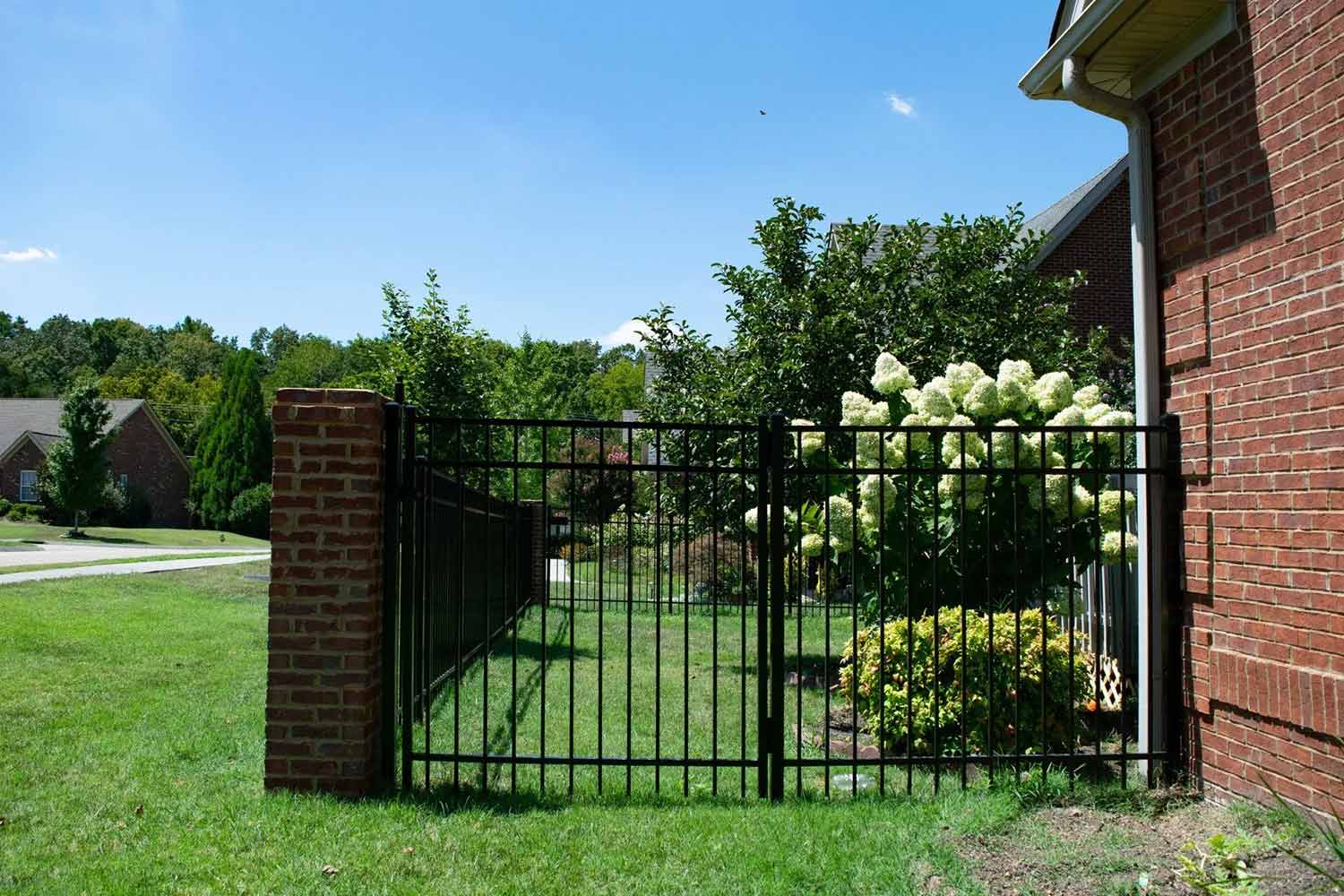
Fence Height and Permit Rules by City in East Tennessee
Short answer: There is no single East Tennessee fence rule. Knoxville, Knox County, Oak Ridge, Maryville and Loudon County each handle height, setback and permits differently — and in several cases the rule people repeat online is wrong. This page puts the actual ordinance language side by side.
Fence rules by jurisdiction
| Jurisdiction | Front yard | Side / rear | On the property line? | Permit |
|---|---|---|---|---|
| City of Knoxville | 42 inches for privacy fences, from 5 ft behind the front building line forward. Open fences: no limit. | No zoning height limit | Yes — no setback required, except the visibility triangle | Not specified in zoning; confirm with Plans Review |
| Knox County (unincorporated) | Effectively 3½ feet — via the vision rule, not a height rule | No height limit in the ordinance | No fence setback imposed | Exempt from building permit |
| Oak Ridge | 4 feet | 6 feet | No — 5 ft from lot lines appears to apply | Yes — Zoning Compliance Permit |
| Maryville | No closer than 5 ft from the street right-of-way | No stated maximum; over 6 ft triggers setbacks | Under 6 ft, apparently yes | No permit — except Historic Districts |
| Loudon County | Not addressed in the zoning resolution | Not addressed | Not addressed | Not addressed |
| Lenoir City | Not addressed in the zoning ordinance | Not addressed | Not addressed | Not addressed |
Knoxville: the 42-inch rule almost nobody gets right
The City of Knoxville Zoning Ordinance, Article 10, § 10.3.L reads:
"From five feet behind the front building line forward to the front lot line and in the corner side yard, privacy fences and walls are limited to 42 inches. Open fences do not have a limit. There is no limit on the height of privacy fences, walls, or open fences in other yards. Fences may be constructed at the boundaries of a lot without setback with the exception of the required visibility triangle."
Three things in there that national permit-lookup sites consistently miss:
- The limit is 42 inches, not 4 feet, and it applies only to privacy fences. An open fence — picket, ornamental aluminum, anything you can see through — has no front-yard height limit at all.
- The measuring datum is five feet behind the front building line, not the front lot line.
- There is no zoning height cap in side and rear yards. The commonly cited "6 foot maximum" is not in Knoxville's zoning code.
One caution worth stating plainly: a search for "Knoxville fence ordinance" will surface the code for Knoxville, Iowa, which says 4 feet front and 7 feet side-rear with a finished-side-out requirement. Those numbers are wrong for Tennessee and they have been copied onto several contractor blogs.
Knox County is a different rule set entirely
If your address is in unincorporated Knox County, the City of Knoxville's ordinance does not apply to you.
The county zoning ordinance contains no fence height limit. What it has instead is § 3.20.04, a vision rule: in front and side yards, nothing may obstruct vision between 2½ and 10 feet above the crown of the adjacent roadway within the visibility triangle, and no fence, wall, hedge or yard ornament may materially impede vision across a front yard above 3½ feet.
The practical effect is a 42-inch front-yard limit arrived at from a completely different direction.
On permits: Knox County amended IRC § R105.2 to exempt "Fences" from building permit — and notably, the county's amendment drops the base code's "not over 7 feet high" qualifier.
Oak Ridge has the most distinctive rule in the market
Oak Ridge caps fences at 4 feet in the front yard and 6 feet in side and rear yards. But § 3.07(e)(2) adds an exception worth knowing: on a corner lot, a decorative fence on the non-facing street side may reach 6 feet if the top two feet are lattice, provided it doesn't overlap required front or rear yards.
Oak Ridge also requires a Zoning Compliance Permit — § 3.08(e): "No structure provided for herein shall be erected without a Zoning Compliance Permit." And § 3.08(b) makes rotten or deteriorated structural members and missing or broken components a code violation, which matters if you're weighing repair against replacement.
These figures come from the ordinance compilation amended through November 2020. Oak Ridge has published a newer compilation; confirm before you build.
Maryville: no permit, but real restrictions
Maryville requires no permit for fences on single-family and two-family properties — except in Historic Districts, which need Historic Zoning Commission approval first.
What it does impose:
- Fences no closer than 5 feet from the street right-of-way, unless the City Engineer finds no sight-distance problem for chain link or similar
- Fences over 6 feet must meet accessory-structure setbacks — 5 feet from rear and side, 10 feet in the Estate Zone; over 12 feet adds 2 feet of setback per additional foot of height
- Fences must be free of barbs, spikes, razor wire, electrical wire and similar hazards
Note what that 6-foot figure is: a trigger for setbacks, not a maximum height. Maryville's brochure states no explicit height cap.
Loudon County and Lenoir City: the rule is the silence
We're based in Lenoir City, so we've read these carefully. Neither the Lenoir City zoning ordinance nor the Loudon County zoning resolution addresses maximum fence height, fence setbacks, or whether a permit is required. That's a genuine absence, not an oversight in our reading.
What they do address:
- Lenoir City § 11-307: corner-lot vision — no obstruction between 3½ and 10 feet within the triangle formed 30 feet from the street intersection
- Loudon County § 3.050: the same vision band, but measured 75 feet along each centerline — considerably larger than Knoxville's
- Loudon County § 4.070(B): pools must be walled or fenced with a latching gate, latch on the inside at least 40 inches up, fence not less than 4 feet
On that last one: the state building code governs where it's stricter. Tennessee adopted the 2018 IRC effective July 16, 2020, which requires a pool barrier at least 48 inches with self-closing, self-latching gates. Build to 48 inches, not 4 feet even.
Farragut, Alcoa and Blount County
We are not going to publish numbers we couldn't verify from a primary source. For these three, call before you design:
- Farragut — Community Development, 865-966-7057. Third-party transcriptions suggest fences may be treated as accessory structures with a 10-foot side and rear setback. If that's accurate it's a major difference from Knoxville, where fences can sit on the line. Confirm it.
- Alcoa — Planning & Codes, 865-380-4730
- Blount County — Building Commission / Codes
Your HOA can be stricter than any of this
Every rule above is a government rule. An HOA covenant is a private contract that runs with the land, and Tennessee has no statewide act that overrides subdivision covenants for single-family homes.
A fence that is perfectly legal under zoning — a 7-foot privacy fence in a Knoxville rear yard, which zoning doesn't limit at all — can still violate your covenants. Architectural Review Committee approval is a separate step from any permit, and in West Knox, Farragut and Hardin Valley subdivisions it's usually the binding constraint.
Sources
- City of Knoxville Zoning Ordinance, Article 10, § 10.3.L and § 10.1.F
- Zoning Ordinance of Knox County, § 3.20.04; Knox County amendments to the 2018 IRC, § R105.2
- Oak Ridge Zoning Ordinance §§ 3.07(e), 3.08(b), 3.08(e), amended through November 2020
- City of Maryville Fence Regulations Brochure and Information Sheet
- Lenoir City Zoning Ordinance § 11-307
- Loudon County Zoning Resolution §§ 3.050, 4.070(B)
- Tennessee State Fire Marshal, adopted codes — 2018 IRC effective July 16, 2020
- Tennessee Code Annotated § 66-27-601, dedicatory instruments
Ordinances change. These citations were verified in September 2026. Always confirm with the jurisdiction that governs your address before you build — and if you're not sure which one that is, that's the first question to answer.