Can You Fence a Family Cemetery on Your Land in Tennessee?
Short answer: Yes. A Tennessee landowner can fence a family cemetery, and fencing is the protection the state itself recommends. But the fence cannot be used to lock out descendants, who have a right to reach the graves at reasonable times, and Tenn. Code Ann. § 46-8-103 bars disturbing the ground within 10 feet of any grave, so posts belong outside that buffer.
LC Fence is a veteran-owned fence contractor that has built farm, residential and commercial fence across East Tennessee since 1973, under Tennessee Unlimited Contractor License #54371. Old family burial grounds are common on farms and wooded tracts in Loudon, Knox, Blount, Monroe and Roane counties, and we get this question from new landowners and from families trying to protect a great-grandparent's grave on land the family no longer owns. Here is what the law says and how to build the fence the right way.
Is it legal to put a fence around a cemetery on my property in Tennessee?
Yes. No Tennessee statute prohibits fencing a cemetery on private land, and both state agencies that handle burial grounds advise doing it.
The Tennessee Department of Environment and Conservation's Division of Archaeology says on its human remains and burials page that "family members should make sure the cemetery is well-marked with a fence and a sign." The Tennessee Historical Commission's cemetery FAQ gives the same advice: family members "should consider marking it well with fences and a sign."
A cemetery does not have to be large to count. Tennessee defines a cemetery in Tenn. Code Ann. § 46-1-102(1) as "any land or structure in this state dedicated to and used, or intended to be used, for interment of human remains," and the Historical Commission notes that "a cemetery can be as small as a single burial." One fieldstone at the edge of a pasture can be a legally protected grave.
Do I have to protect a cemetery on land I bought?
If your deed shows a gravesite, yes. Tennessee puts a duty on the buyer to keep it from being disturbed, and a fence is the simplest way to meet that duty.
Chapter 8 of Title 46 exists, in its own words, "to provide notice to buyers of property with known burial grounds and gravesites" (§ 46-8-101). Under § 46-8-103(a), a deed that shows a gravesite or crypt "obligates the immediate and future buyer or buyers of the property to protect the gravesite or crypt from disturbance." The seller is responsible for making sure the deed reflects the graves before the sale.
Protecting is not the same as maintaining. The Historical Commission states that "a landowner in Tennessee is not obligated to maintain a cemetery, whether or not it is present on a deed." You do not have to mow it or straighten stones. You do have to keep from damaging it, and keep cattle, equipment and builders off of it.
How close to a grave can I put a fence post?
Keep every post hole at least 10 feet outside the outermost grave, and at least 5 feet from any crypt. That is the no-disturbance buffer in state law.
Section 46-8-103(b) is short and specific: "A gravesite may not be disturbed in the area of ten feet (10') surrounding the perimeter of the gravesite," and "A crypt may not be disturbed in the area of five feet (5') surrounding the perimeter of the crypt." Digging a post hole is disturbing the ground, so the safest way to read the statute is to set the whole fence line outside those buffers. It also gives room to mow and open a gate without walking on graves.
| Rule | What it requires | Source |
|---|---|---|
| Gravesite buffer | No disturbance within 10 ft of the grave perimeter | Tenn. Code Ann. § 46-8-103(b) |
| Crypt buffer | No disturbance within 5 ft of the crypt perimeter | Tenn. Code Ann. § 46-8-103(b) |
| Buyer's duty | Protect a deeded gravesite from disturbance | Tenn. Code Ann. § 46-8-103(a) |
| Damaging a cemetery fence | Destroying a "fence or enclosure in or around" a cemetery is a Class E felony | Tenn. Code Ann. § 46-2-105 |
| Desecrating a burial place | Intentional desecration of "a place of worship or burial" is a Class E felony | Tenn. Code Ann. § 39-17-311 |
| Finding remains | Stop digging; notify the coroner or medical examiner and local law enforcement | Tenn. Code Ann. § 11-6-107(d) |
| Descendant access | Ingress and egress from the nearest public road at reasonable times | Hines v. State (Tenn. 1911) |
In practice, the hard part is finding the edge of the cemetery. Old East Tennessee family plots were often marked with plain fieldstones, a row of cedars, or nothing at all, and later graves may sit outside the original fence. Sunken rectangles in the ground, periwinkle or yucca growing where nothing else was planted, and stones set on end are all signs of graves. If the boundary is unclear, have the cemetery located before you lay out the fence. Our post on whether you need a survey before building a fence covers how surveyors handle old monuments.
Can I lock the gate or keep relatives out of a cemetery on my land?
No. You can fence the cemetery and put a gate on it, but you cannot use the fence to block descendants from visiting.
The rule comes from the Tennessee Supreme Court. In Hines v. State (1911), the court held that relatives "have the right to visit the cemetery for the purpose of repairing, beautifying, and protecting the graves and grounds, and, for these purposes, they have a right of ingress and egress from the nearest public road, to be exercised at reasonable times and in a reasonable manner." The Historical Commission puts it plainly: "descendants and their guests have the perpetual right to visit any cemetery in which their ancestor(s) are buried," and "access to the cemetery is not blocked intentionally by a property owner."
That right has limits on both sides. The Commission notes that "state law does not currently require the property owner to maintain such a path," so you do not have to build a road. And "reasonable times and in a reasonable manner" means visitors should not be cutting your pasture fence or showing up at midnight. What works on most farms:
- A gate on the cemetery fence that latches but is not padlocked, or a padlock with a key or combination shared with the family.
- A walk gate in your perimeter or pasture fence along the route from the road, so visitors do not have to climb wire or leave a cattle gate open.
- An agreed route and a phone number, so the family can call ahead.
If you post the rest of your land against trespass, the cemetery route is the exception. Our article on the Tennessee purple paint law explains how posting works.
Can I remove a fence that is already around an old cemetery?
Not by tearing it down. A fence around a cemetery is protected by its own statute.
Tenn. Code Ann. § 46-2-105, as compiled by the Tennessee Historical Commission, makes it an offense to willfully destroy or injure any monument, gravestone or structure in a cemetery, "or any roadway, walk, fence or enclosure in or around the same," and states: "A violation of this section is a Class E felony." Separately, § 39-17-311 makes it an offense to intentionally desecrate "a place of worship or burial," also a Class E felony.
Replacing a rusted or rotted cemetery fence with a better one is a different thing from removing it. If an old woven-wire or iron fence is falling down, the sensible course is to talk with the family if you can find them, document the old fence with photos, and build the new one outside the 10-foot buffer before the old one comes out, so the graves are never left open to livestock.
What if I want the graves moved so I can use that ground?
That takes a chancery court order. You cannot fence the graves out of the way, build over them, or relocate them on your own.
Under § 46-8-103(c), an owner whose deed shows graves may transfer the remains at the owner's expense through the termination-of-use procedure in Chapter 4 of Title 46, and must first publish notice in a newspaper of general circulation in the county. Sections 46-4-101 through 46-4-104 set out the suit in the chancery court of the county where the burial ground sits, with publication for unknown defendants, and the court will order removal only when "the removal and reinterment of all the remains will be done with due care and decency." The Historical Commission adds that relatives "must be given legal notice, but no permission from said relatives is required," and that a disinterment permit from the Tennessee Department of Health is also required. Until that process is complete, the ground keeps its cemetery status.
For most landowners, fencing the plot and working around it is faster and far cheaper than a court case and reinterment.
What should I do if we hit a grave while digging post holes?
Stop immediately and make the calls the law requires. Do not keep digging to "see what it is."
Tenn. Code Ann. § 11-6-107(d) says anyone who "encounters or accidentally disturbs or disinters human remains" on public or private land shall "immediately cease disturbing the ground in the area of the human remains" and "notify either the coroner or the medical examiner, and a local law enforcement agency." Failing to do either is a Class A misdemeanor. The Division of Archaeology also asks to be notified. This is one reason we hand-dig or probe carefully near any suspected burial ground instead of running an auger blind.
How do you build a fence around a family cemetery?
Locate every grave, lay the fence out at least 10 feet beyond the outermost one, call 811, and set the posts by hand. Here is the order we follow.
- Find the graves. Walk the plot for fieldstones, depressions and old plantings. Check the deed and any old survey. If graves may extend past the visible stones, have the area probed or scanned before layout.
- Lay out the fence line. Mark a rectangle that keeps every post at least 10 feet from the outermost grave and 5 feet from any crypt. Square corners make a cleaner job and a simpler gate.
- Call Tennessee 811. State law requires notice at least three working days before digging. Rural cemeteries often sit near old water lines and buried electric runs to barns. See our 811 guide.
- Plan the gate and access route. A 4-foot walk gate is enough for visitors; a 5- or 6-foot gate lets a push mower or small tractor through. Put it on the side that faces the route from the road.
- Dig carefully. East Tennessee clay and limestone rock make post holes slow, and near graves we avoid heavy equipment. If a hole hits anything that looks like a box, bone, or a laid stone, work stops.
- Keep livestock out for good. If the cemetery sits in pasture, cattle rubbing on stones is the most common damage we see. Build the cemetery fence stout enough to turn cattle, or set it inside your existing livestock fence.
What kind of fence works best around a cemetery?
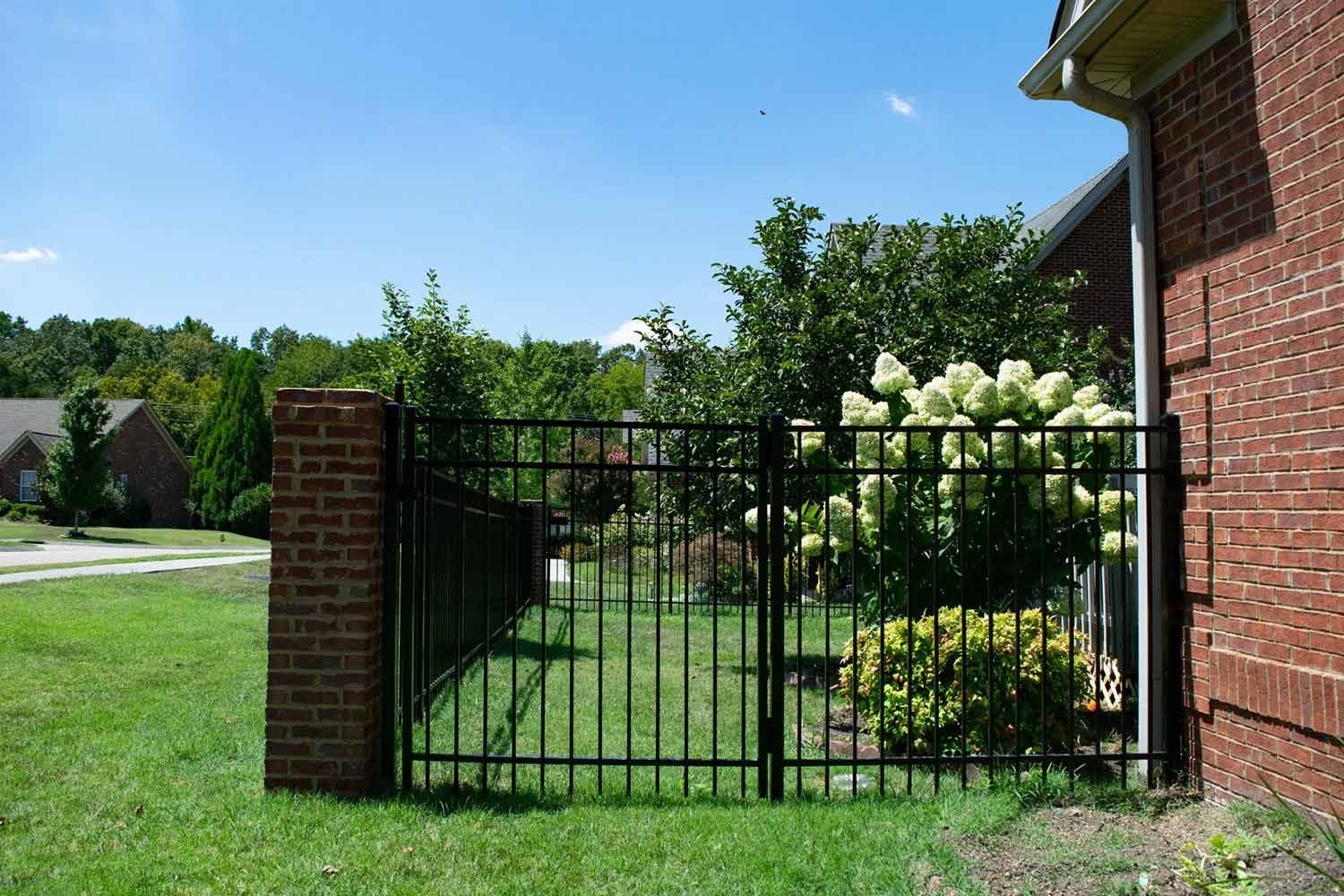
Ornamental aluminum is the most common choice because it lasts, needs no paint, and lets visitors see the stones. Wood and chain link also work depending on budget and setting.
| Fence type | Installed price range | Why people choose it | Watch for |
|---|---|---|---|
| Ornamental aluminum | $24-70 per ft | Traditional look, no rust or paint, stones stay visible | Needs a stouter fence outside it if cattle are close |
| Wood picket or board | $14-50 per ft | Fits a farm setting, classic family plot look | Needs stain or paint over time |
| Chain link | $10-40 per ft | Lowest cost, turns livestock and dogs | More utilitarian look; black coating blends in better |
A small family plot fenced at the 10-foot buffer usually runs somewhere around 100 to 200 linear feet, plus a gate. Slope, rock, access for equipment and gate size move the price, which is why we give a firm number only after seeing the site. See our fence cost guide for how pricing works, or browse our farm fence options if the cemetery sits in pasture.
Key facts
- Tennessee law allows landowners to fence a cemetery on private land, and the Division of Archaeology and Historical Commission both recommend a fence and a sign.
- Under Tenn. Code Ann. § 46-8-103(b), ground may not be disturbed within 10 feet of a gravesite or 5 feet of a crypt.
- A buyer whose deed shows a gravesite must protect it from disturbance, but is not required to maintain the cemetery.
- Descendants have a right of ingress and egress from the nearest public road to visit family graves at reasonable times, under Hines v. State (Tenn. 1911); a fence or gate cannot be used to block them.
- Destroying a fence or enclosure around a cemetery is a Class E felony under Tenn. Code Ann. § 46-2-105.
- Moving graves requires a chancery court order under Tenn. Code Ann. §§ 46-4-101 to 46-4-104 and published notice.
Need a fence around a family cemetery?
We have built fence on East Tennessee farms for more than 50 years, and we know how to work carefully around old burial grounds. We will walk the plot with you, lay the fence outside the legal buffer, plan the gate and the visitors' route, and build something that keeps cattle out for decades. Call LC Fence at (865) 988-9935 or request a free on-site estimate. We are at 5482 Hwy 321 N in Lenoir City. More answers to common questions are on our fence answers page.
This article is general information, not legal advice. If a cemetery's boundary, ownership or access is disputed, talk with a Tennessee attorney before you build.