Can You Put a Fence on TVA Shoreline Land in Tennessee?
Usually not. On TVA-owned shoreland along lakes like Fort Loudoun, Tellico, Melton Hill and Watts Bar, federal rules bar permanent structures, and a fence is allowed only where agricultural or fencing rights exist and the land is farmed. If you own the land and TVA holds a flowage easement, a fence is treated as an obstruction and needs TVA Section 26a approval first.
Loudon County Fence is a veteran-owned fence contractor based in Lenoir City, a few minutes from Fort Loudoun Dam, and we have built fences across East Tennessee since 1973. Lake lots are some of the most common places we see a fence planned in the wrong spot, because the line between your yard and TVA's land is rarely where it looks like it should be.
Who controls the shoreline on East Tennessee lakes?
On most lakes in our area, the Tennessee Valley Authority (TVA) either owns a strip of land between private lots and the water or holds a flowage easement over the lower part of private lots. Which one applies to your lot decides whether you can fence near the water at all.
TVA operates the reservoirs most East Tennessee lake homes sit on. Fort Loudoun Reservoir runs on the Tennessee River at Knoxville, has 379 miles of shoreline, and its dam, completed in 1943, sits in Lenoir City (TVA, Fort Loudoun). Tellico Reservoir stretches 33 miles along the Little Tennessee River with 357 miles of shoreline, was completed in 1979, and sends its water through a short canal into Fort Loudoun (TVA, Tellico). That is more than 730 miles of shoreline on just two lakes in Loudon, Knox, Blount and Monroe counties, and nearly every foot of it falls under one of the categories below.
The rules come from Section 26a of the TVA Act and TVA's regulations at 18 CFR Part 1304. Two terms matter:
- TVA-owned residential access shoreland is land TVA owns outright between private lots and the water, where adjacent owners can apply for permission to reach the lake. These rules are in Subpart C.
- TVA flowage easement shoreland is land you own, but where TVA holds the right to flood it. These rules are in Subpart D.
Can I put a fence on TVA-owned shoreland?
Almost never for a typical home. TVA's rule limits fences on its residential access shoreland to agricultural situations, and requires public pedestrian passage even then.
The regulation, 18 CFR 1304.209(d), reads in full:
"Fences crossing TVA residential access shoreland may be considered only where outstanding agricultural rights or fencing rights exist and the land is used for agricultural purposes. Fences must have a built-in means for easy pedestrian passage by the public and they must be clearly marked."
The general rule in the same section, 1304.209(a), is even broader: "Except for steps, pathways, boat launching ramps, marine railways located in the access corridor, bank stabilization along the shoreline, and other uses described in this subpart, no permanent structures, fills or grading shall be allowed on TVA land." Paragraph (b) adds that even items like picnic pavilions and gazebos are not allowed there.
In plain terms: a privacy fence, a dog fence, or a decorative aluminum fence running down to the water across TVA land is not something TVA's rules allow for a residential lot. A farm with recorded fencing rights is the narrow exception, and that fence still has to let the public walk through.
What if TVA only has a flowage easement on my land?
You can apply, but you need TVA's approval before you build. Any structure on flowage easement land is legally an obstruction under Section 26a.
The rule is 18 CFR 1304.300: "Any structure built upon land subject to a flowage easement held by TVA shall be deemed an obstruction" affecting navigation, flood control, or public lands. The same section says the TVA-land fence restriction in 1304.209 does not apply to flowage easement land, so a fence is not automatically off the table there. It goes through the permit process instead.
TVA's application rule, 18 CFR 1304.2(c)(1), names fences directly: "By way of example only, minor facilities may include: boat docks, piers, rafts, boathouses, fences, steps, gazebos, and floating cabins." It also notes that "Most residential related facilities are minor facilities," which means a simpler application than a major project.
Keep in mind that flowage easement land floods by design. TVA keeps the right to raise the water over it, and a fence there will take debris and standing water when that happens. When we build in these zones, we plan for it: open designs like ornamental aluminum or chain link pass water and debris far better than solid privacy panels.
How do the three kinds of lakefront land compare?
The short version: on TVA land, no; on flowage easement land, only with a 26a permit; above both, normal local rules apply.
| Land type | Who owns it | Can you fence it? | Approval needed | Rule |
|---|---|---|---|---|
| TVA-owned residential access shoreland | TVA (federal) | Only where agricultural or fencing rights exist and the land is farmed; must allow public passage | TVA permit before any activity | 18 CFR 1304.209(a), (d); 1304.201 |
| Private land under a TVA flowage easement | You, subject to TVA's right to flood | Possibly; a fence is an "obstruction" | TVA Section 26a approval | 18 CFR 1304.300; 1304.2(c)(1) |
| Private land above the TVA line | You | Yes, under city or county rules | Local zoning, HOA, and TN 811 | Your city or county code |
Do I need a TVA permit just to clear a fence line near the water?
Yes, if the clearing is on TVA land. TVA requires advance permission for vegetation work on its residential access shoreland, and it keeps a 50-foot buffer along the water.
Under 18 CFR 1304.203(e), "A 50-foot-deep shoreline management zone (SMZ) shall be designated by TVA on TVA property," and "Within the SMZ, no trees may be cut or vegetation removed, except that which is preapproved by TVA within the access corridor." Section 1304.201 says landowners who want to build facilities, clear vegetation, or maintain an access corridor on adjacent TVA land "are required to apply for and obtain a permit from TVA before conducting any such activities."
This catches people who are only trying to brush-hog a path for a fence crew. Cutting brush or trees on TVA land without approval is its own violation, even if no fence ever goes in. On flowage easement land you own, 1304.302 says vegetation work generally does not need TVA approval, though TVA may still consider effects on sensitive resources.
What happens if a fence goes up on TVA land without approval?
TVA can order it removed and charge you for the removal. It can also block future permits, including for a dock, until those costs are paid.
TVA's rule on unauthorized structures, 18 CFR 1304.406, allows TVA to remove a structure built "in a manner inconsistent with this part" if the owner fails to repair or remove it "within ninety (90) days after written notice from TVA." It states that "TVA's removal costs shall be charged to the owner of the structure" and that "payment of such costs shall be a condition of approval for any future facility." TVA's Public Land Protection Policy FAQ lists "placement or construction of a structure on public land without the permission of TVA" as a violation and says TVA may pursue "removal of the structure, revocation of the contract or in some cases court action."
For a lake homeowner, losing the ability to get a dock permit is often a bigger problem than losing the fence. That alone is a good reason to confirm the boundary before a single post goes in.
How do I find out where my land ends and TVA's begins?
Start with your deed and recorded plat, then look for TVA boundary markers on the ground, and call TVA if anything is unclear. Do not assume the water's edge, the mowed lawn, or the old fence is the line.
- Read your deed and plat. Look for references to TVA, a "flowage easement," or a contour elevation. Lake lots often describe a boundary by an elevation line rather than a straight survey line.
- Walk the lot for markers. TVA says visitors may see "TVA property boundary markers or TVA Public Land signs" along its land.
- Call the TVA Public Land Information Center at 1-800-882-5263 or email plic@tva.gov. TVA lists this contact in its permit rules and FAQ.
- Get a survey if the line is close. If the fence is planned anywhere near the boundary, a licensed surveyor staking the line costs far less than removing a fence.
- Set the fence on your side. Once the line is known, we lay out the fence so posts, concrete and gate swings all stay on private land above the TVA line.
How do I apply for TVA approval for a fence?
Apply online through TVA's Section 26a system, with a drawing, a photo, and the fee. Expect a review of roughly 100 to 120 days for minor projects.
TVA's application instructions say that "Beginning October 1, 2025, TVA will only accept Section 26a applications submitted through our online application system." Each facility needs a drawing showing "the principal dimensions, size and location in relation to the shoreline and adjacent property boundaries," and at least one photograph of the property. For timing, TVA says, "For minor construction activities we strive to issue permits within 100 days," and notes it can stretch to 120 days. Under 18 CFR 1304.2(c), an application is not complete until the fee is paid. TVA's page lists a $1,000 application fee for many docks, boathouses and similar projects; confirm the fee for your project type with TVA, since paying it "does not guarantee approval of the permit."
Plan around that timeline. If you want a fence on flowage easement land by spring, the application should go in during the fall or early winter.
What local rules apply to a lake-lot fence above the TVA line?
The same rules as any other lot in your city or county, plus your HOA if you have one. TVA's rules stop at its land and easements, but local zoning does not.
A few examples we work with regularly: inside City of Knoxville limits, privacy fences are limited to 42 inches from five feet behind the front building line forward to the front lot line (Knoxville Zoning Code, Article 10, Section 10.3.L), and fences are prohibited in utility and drainage easements (Section 10.1.E). The Town of Farragut does not require a building permit for fences up to 7 feet. Before any digging in Tennessee, the law requires a locate request through Tennessee 811 at least three working days ahead. On lake property that matters more than usual, because private lines to docks, boat lifts and shoreline lighting are common and 811 does not mark private lines. We cover that in detail in do you have to call 811 before digging fence posts in Tennessee, and easements in can you put a fence on an easement in Knoxville.
What kind of fence works best on an East Tennessee lake lot?
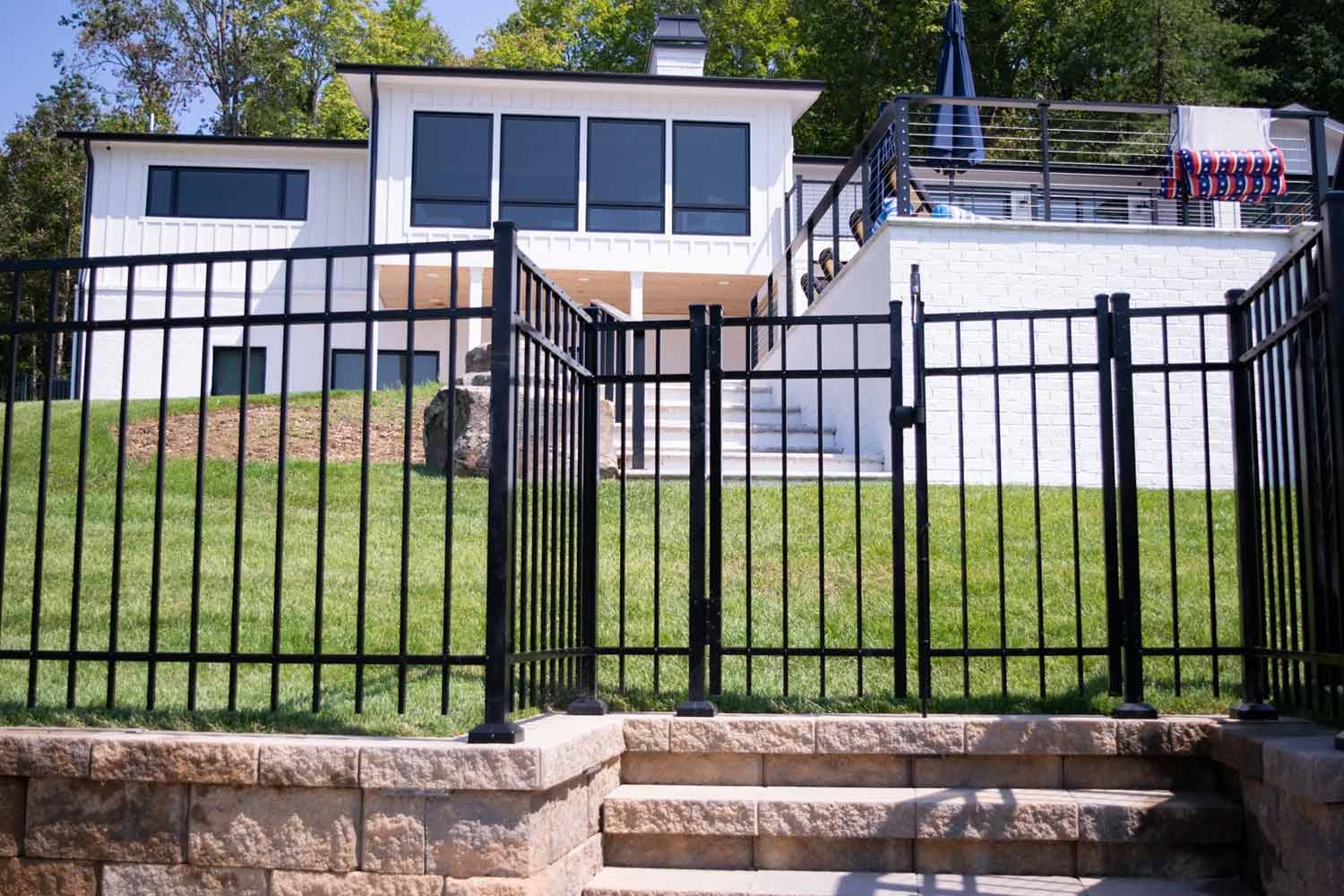
Most lake owners want to keep the view, so 4- or 5-foot ornamental aluminum is the most common choice we install near the water. It is open, rust-resistant, and follows slopes well.
Lake lots here are rarely flat. The ground usually drops toward the water, often over red clay and limestone rock just below the surface, and many lots have retaining walls. That shapes the build:
- Slope. Aluminum panels can be racked to follow a grade or stepped down in sections. Wood and vinyl privacy panels are usually stepped, which leaves gaps underneath on steep ground.
- Rock and clay. We expect to hit rock on many lakefront lots and budget for core drilling or adjusted post layouts. Wet clay near the water also holds moisture, so post setting and drainage matter more here.
- Gates. Plan a gate wide enough for the path to your dock and for equipment. If TVA has approved an access corridor, the gate should line up with it.
- Pools. If the fence doubles as a pool barrier, it has to meet pool barrier requirements as well. See our fence answers page for the basics.
Installed prices for ornamental aluminum typically run $24 to $70 per foot, depending on height, style, slope and rock. Our fence cost guide breaks down the other materials, and our ornamental fencing page shows styles we install.
Key facts
- On TVA-owned residential access shoreland, fences "may be considered only where outstanding agricultural rights or fencing rights exist and the land is used for agricultural purposes" (18 CFR 1304.209(d)).
- Any structure on private land subject to a TVA flowage easement "shall be deemed an obstruction" and needs Section 26a approval (18 CFR 1304.300).
- TVA lists fences as an example of a minor facility in its permit rules (18 CFR 1304.2(c)(1)).
- TVA keeps a 50-foot shoreline management zone on its land where no trees may be cut or vegetation removed without preapproval (18 CFR 1304.203(e)).
- Since October 1, 2025, TVA accepts Section 26a applications only online, and minor permits take roughly 100 to 120 days.
- TVA's Public Land Information Center is 1-800-882-5263.
Get your lake-lot fence planned right the first time
We build fences on lake property around Fort Loudoun, Tellico, Melton Hill and Watts Bar, and we can help you figure out where your fence can go before anything is ordered. Call Loudon County Fence at (865) 988-9935 or request a free on-site estimate. We are based in Lenoir City and serve Lenoir City, Loudon County, Knoxville and the surrounding area.
This article is general information, not legal advice. TVA rules and local codes change, so confirm your specific property with TVA and your local codes office before building.