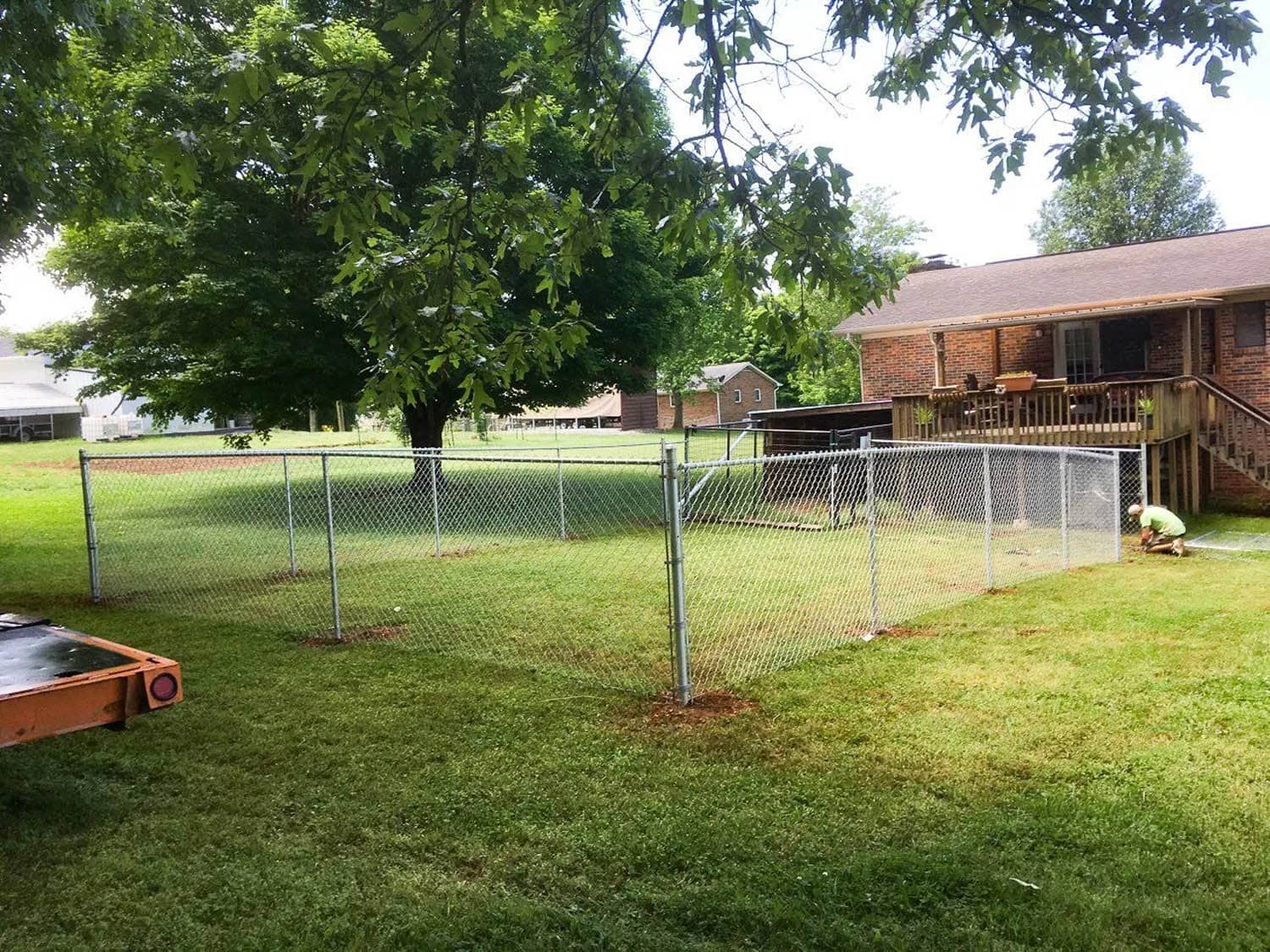
Can You Keep Chickens in Knoxville? Fence & Coop Rules
Yes. Inside Knoxville city limits you can keep up to six hens, and no roosters, with a $25 annual Domesticated Hen Permit from Young-Williams Animal Services. The hens must live in a fenced enclosure that is covered or at least 42 inches high, set at least 10 feet from every property line, and never in the front yard.
Loudon County Fence is a veteran-owned fence contractor that has built fence across East Tennessee since 1973. This guide covers what the City of Knoxville rule actually says, what it means for the fence and run you build, and what changes outside city limits.
What does the Knoxville chicken ordinance allow?
Six hens per permitted home, personal use only, with a fenced run and a locking henhouse. The rule lives in Knoxville City Code Chapter 5, Article IV, Section 5-107, and the city's zoning code was amended to allow "domesticated chickens" in residential districts by Ordinance O-165-2010, which took effect December 17, 2010, according to the Knoxville-Knox County Planning case summary.
The current permit application from Young-Williams Animal Services, which administers the permit for the city, spells out the terms:
- Up to 6 hens. Multifamily complexes without individually owned backyards are capped at 6 hens for the whole complex.
- Hens only. No roosters, and no ducks, geese, turkeys or other poultry.
- No selling, breeding or slaughter. Eggs are for your household, not for sale.
- $25 per year. The permit runs through December 31 and must be renewed every year.
- Primary residence. You must live there. Renters need the property owner's approval, and the permit is void if you are away from the property for more than 30 days.
- Fines. Violations are civil offenses with fines up to $50, and each day counts as a separate offense.
What kind of fence does a chicken run need in Knoxville?
A fully enclosed run with either a cover over the top, or walls at least 42 inches high with every hen's wings clipped. The permit terms are direct: "Hens must be kept in a fenced enclosure at all times." The enclosure "must be either: (i) covered, or (ii) at least forty-two (42) inches high," and in the uncovered case "all hens must be wing-clipped to prevent escape."
From a fence builder's point of view, the 42-inch option is the legal minimum, not the practical one. A 42-inch run keeps hens in, but it does nothing about what comes over the top. In East Tennessee that means hawks by day and raccoons, which climb, by night. A covered run solves both problems and removes the wing-clipping requirement.
| Run style | Meets Knoxville rule? | Wing clipping required? | Stops hawks? | Stops climbing predators? |
|---|---|---|---|---|
| Open run, under 42 in | No | N/A | No | No |
| Open run, 42 in or taller | Yes | Yes | No | No |
| Covered run, any height | Yes | No | Yes | Yes, if the cover is solid wire |
| Hens loose in a fenced backyard | No, unless the yard itself is the enclosure and meets every rule | Depends | No | No |
That last row catches people. A privacy fence around the whole backyard is not automatically a legal chicken enclosure, because the enclosure also has to sit 10 feet off every property line, and most backyard fences are built right on or near the line.
How far from the property line does a coop have to be?
At least 10 feet from any abutting property line, for both the henhouse and the run. The permit terms read: "Neither the henhouse nor the fenced enclosure may be located less than ten (10) feet from any abutting property line." And: "Henhouses and enclosures shall not be permitted in front yards."
The practical effect is that you cannot use your existing boundary fence as one wall of the run, which is the most common way people try to save money on a chicken pen. The run needs its own four sides, set in from the line. On a typical Knoxville lot that means planning the run near the middle of the backyard, not tucked into a back corner against the neighbor's fence.
Before you place it, confirm where the line actually is. Corner pins and a recorded plat are better evidence than an old fence. When a survey is worth paying for.
How big does the run and henhouse have to be?
At least 6 square feet of run and 2 square feet of henhouse per hen, and the henhouse can be no larger than 100 square feet. Those are minimums from the permit terms. Here is what they work out to:
| Hens | Minimum henhouse | Minimum run | Example run that clears the minimum |
|---|---|---|---|
| 2 | 4 sq ft | 12 sq ft | 3 ft x 4 ft |
| 4 | 8 sq ft | 24 sq ft | 4 ft x 6 ft |
| 6 (city maximum) | 12 sq ft | 36 sq ft | 6 ft x 6 ft |
Minimum is not the same as comfortable. Six hens in 36 square feet will turn the ground to bare mud by the first wet East Tennessee winter. A run in the range of 8 by 10 or 10 by 12 feet gives birds room, gives you room to walk in and clean, and is still easy to fit 10 feet off every line on most city lots.
The henhouse itself has construction rules too. It must be enclosed on all sides with a roof and doors that can be shut and locked at night, and any openings or vents need wire with openings smaller than one inch. Hens "shall be secured within the henhouse during non-daylight hours."
What fence material works best for a chicken run?
Galvanized or vinyl-coated chain link, or heavy welded wire, with a buried apron and a wire top. Light poultry netting keeps chickens in but will not stop a dog or raccoon that is determined to get through.
The University of Tennessee Institute of Agriculture publication D 168, Raising Your Own Backyard Chickens in Tennessee, recommends confining birds with fencing and a covered run as the best protection from predators, and gives a specific digging defense: "Bury the fencing wire and turn it outward for 10-12 inches under the surface."
| Material | Strengths | Weak points |
|---|---|---|
| Chain link (kennel-style panels or posts and fabric) | Strong against dogs and coyotes, long-lasting, easy to add a gate and a wire top | Openings are too large to stop small predators alone; line the lower section with smaller-mesh wire |
| Welded wire | Smaller openings, stiff, affordable | Lighter gauges bend and rust; needs solid posts and bracing |
| Hardware cloth | Very small openings, best for henhouse vents and the bottom of run walls | Costly over large areas; not a structural fence by itself |
| Poultry netting (hex wire) | Cheap, light | Keeps hens in, does not keep predators out |
A common, durable build is a chain link enclosure for strength, a band of smaller-mesh wire along the bottom couple of feet, a wire apron buried and turned outward, and a wire or chain link top. If you already have dogs, the chain link frame is the part that matters most.
How do you get a hen permit in Knoxville?
Apply to Young-Williams Animal Services with photos and dimensions of the coop and run. The steps:
- Confirm you are inside Knoxville city limits. A Knoxville mailing address does not mean city jurisdiction. Look your parcel up on KGIS.
- Check your HOA covenants. A city permit does not override private deed restrictions. How HOA approval works in Knox County.
- Plan the run and henhouse in the backyard, at least 10 feet from every property line, sized at 6 square feet of run and 2 square feet of house per hen at minimum.
- Call 811 before digging posts. Tennessee 811 needs 3 working days' notice, and buried electric or gas lines often run through backyards. The 811 rules for fence posts.
- Build the enclosure and henhouse, then photograph both and measure them in feet and inches.
- Submit the application and the $25 fee to Young-Williams Animal Center, Attn: Animal Services Admin - Permits, 3201 Division Street, Knoxville, TN 37919.
- Renew every year. Permits expire December 31.
What about chickens outside Knoxville city limits?
The city permit does not apply in unincorporated Knox County, Farragut, Maryville, Lenoir City or any other town. Each sets its own rules.
In unincorporated Knox County, the zoning ordinance governs. A 2011 Knoxville-Knox County Planning staff review, case 8-B-11-OA, noted that poultry farming is a permitted use in the county's Agricultural (A) zone, while residential zones are a different question. If you are in a residential zone outside the city, call Knox County Codes Administration before you buy birds.
In the surrounding towns, check the city code or call the codes office first. Rules on hens, roosters and setbacks vary widely from one town to the next, and an HOA can prohibit chickens even where the town allows them.
Do you need a fence permit for a chicken run?
The hen permit is a separate thing from any fence or building rule. The chicken rules tell you where the run can go and how it must be built; your city's zoning and fence rules still apply to any fence you put up on the lot. Inside Knoxville, for example, a privacy fence in front of a line 5 feet behind the front building line is limited to 42 inches under Article 10, Section 10.3.L of the city zoning code. A backyard run set 10 feet off the lines is generally well clear of the front-yard issue, but if you are adding or replacing a full backyard fence at the same time, read how tall a fence can be in Knoxville and whether your fence needs a permit.
What does a chicken run fence cost?
Price follows the perimeter. A 10 by 12 foot run has about 44 feet of perimeter. At our installed range for chain link of $10 to $40 per linear foot, that is roughly $440 to $1,760 before a gate, a covered top or a buried apron. Height, terrain, rock and access all move the number. Full fence cost breakdown.
On East Tennessee ground, the posts are where a small run succeeds or fails. Clay that swells when wet and shrinks when dry works shallow posts loose, and a run with a wire top puts extra load on the corners. Shallow rock is common across Knox and Loudon counties and can stop a hole short, which is why post setting gets decided on site after seeing the ground.
Key facts
- Knoxville allows up to 6 hens, and no roosters, under City Code Section 5-107.
- A Domesticated Hen Permit from Young-Williams Animal Services costs $25 per year and expires December 31.
- Hens must be kept in a fenced enclosure at all times: covered, or at least 42 inches high with wings clipped.
- The henhouse and run must be at least 10 feet from every abutting property line and are not allowed in front yards.
- Minimum space is 2 square feet of henhouse and 6 square feet of run per hen; the henhouse cannot exceed 100 square feet.
- The city permit does not apply in unincorporated Knox County or other towns, which set their own rules.
Get a free estimate on a run or backyard fence
We build chain link and kennel-style enclosures and full backyard fences across Knoxville and ten East Tennessee counties. We will look at the lot, help you place the run where it meets the 10-foot rule, and give you a written price at no charge.
Call (865) 988-9935 or request a free on-site estimate. More common questions are on our fence answers page.
Summarized from the City of Knoxville Domesticated Hen Permit terms (City Code Chapter 5, Article IV, Section 5-107) as published by Young-Williams Animal Services, current as of November 2026. Rules can change; confirm with Young-Williams or the City of Knoxville before you build. General information, not legal advice.