Farm, Horse & Livestock Fencing in East Tennessee
On acreage the wire is almost never what fails. Corner and gate bracing is what decides whether a farm fence holds, and post depth decides whether it stays standing in East Tennessee clay. Everything else is preference.
What Fence for What Animal
Cattle
Woven wire and board fence are the standard answers, with high-tensile on larger tracts. Cattle push and lean, so the fence has to resist steady pressure rather than just mark a line. Barbed is common and works, though it does not suit every operation.
Horses
Board fence or a smooth wire system rather than barbed. Horses lean and push like cattle, but barbed causes injuries that cattle generally avoid. Visibility matters too — a horse needs to see the fence, which is why board and coated high-tensile suit them better than thin wire.
Goats and sheep
Woven wire with tighter spacing. Goats in particular will exploit any gap, and a fence that contains cattle will not necessarily contain goats.
Property line only, no livestock
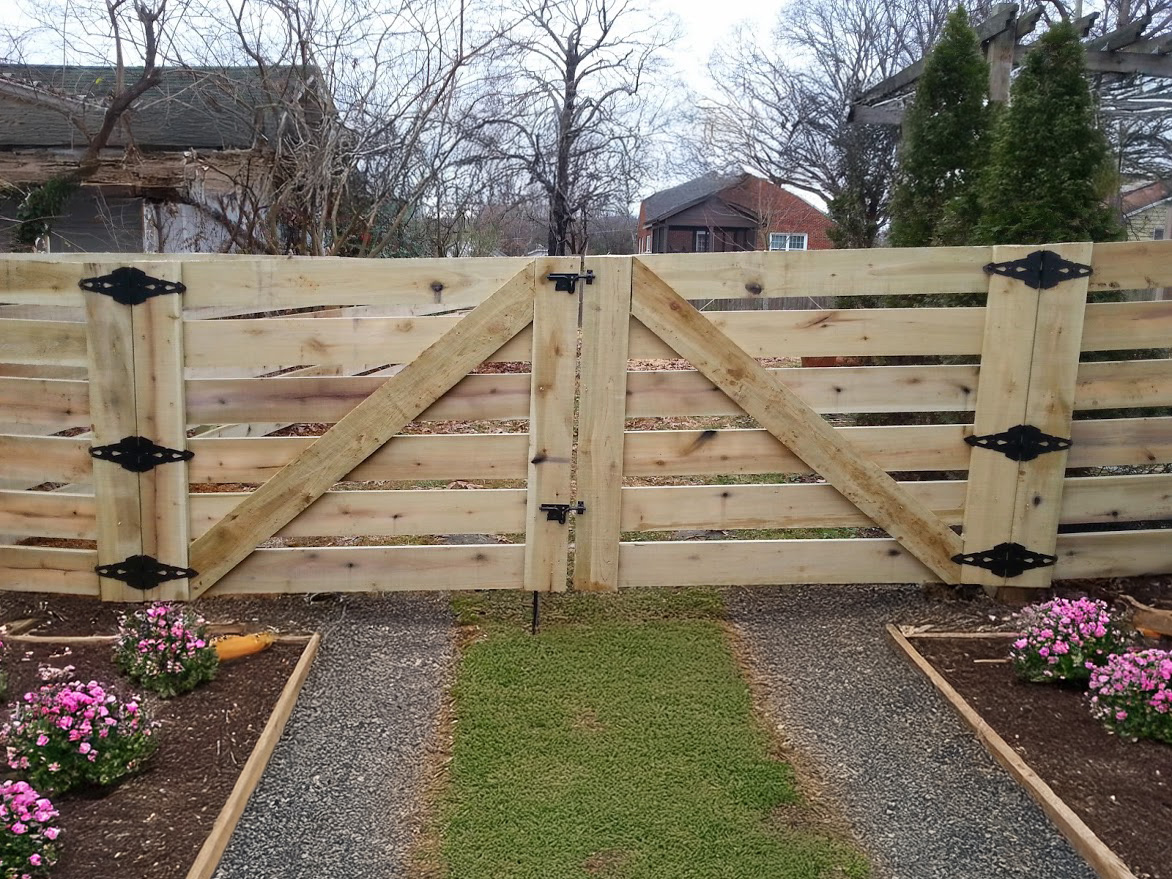
Split rail or three-board looks right on rural frontage and costs less than containment fence. If nothing needs to be held in, you are buying appearance and boundary definition rather than strength.
Why Bracing Matters More Than Wire Gauge
Every run of fence pulls against its corners. A weak corner assembly takes the whole line out of alignment within a season — and on a thousand feet of fence, correcting that costs more than building it properly did.
H-brace and diagonal brace assemblies at every corner, gate and change of direction are what hold tension. That is where the money should go on a farm fence, not into heavier wire.
Post Depth in East Tennessee Clay
Expansive red clay swells when saturated and shrinks as it dries. That repeated movement works shallow posts out of plumb over a few seasons.
The working rule is about a third of the above-ground height, with a practical minimum near 24 inches — and corner and gate posts deeper still, because everything pulls against them.
Where shallow rock stops a hole going deep, the cheap response is to set the post shallower. That is exactly the post that leans first. More on why depth and drainage decide it.
What Farm Fence Costs
Roughly $12 to $30 per linear foot installed, depending on type, terrain and gates.
Scale matters more than it does on a town lot. An acre enclosed on four sides is roughly 835 linear feet if the parcel is square — broadly $10,000 to $25,000. Irregular parcels need more fence than square ones, and every corner adds a brace assembly.
Gate placement is worth planning rather than defaulting. A gate in the wrong place costs you time on every pass for the life of the fence.
Who Pays for the Fence on the Line
A fence on the boundary is a partition fence under Tennessee Code § 44-8-202, and adjoining owners generally share the cost of building and repairing it.
Two provisions worth knowing:
- Where one property is agricultural and the other is not, the owner of the non-agricultural land may file a written disclaimer of responsibility.
- If owners cannot agree on cost, either may ask a judge of the court of general sessions to intervene. The judge appoints three disinterested freeholders — neutral local property owners — to examine the fence and determine what is owed.
A neighbour also cannot simply remove a shared fence. Tennessee restricts removing a partition fence without mutual consent and generally requires substantial written notice, and removing or damaging another owner's fence can carry criminal penalties. Full explanation of partition fence law.
Lines Running Through Woods
Clear the line first and establish the boundary before setting anything. Tennessee has no statute that draws your line — the deed and county plat govern, and a fence left in the wrong place long enough can affect where the legal line runs.
On wooded tracts a survey usually costs less than moving fence later.
Call 811 Before You Dig
Post holes count as excavation under Tennessee law, and the locate takes about three business days.
The part that catches people on acreage: private lines are never marked. Runs to barns, wells, pumps, septic fields and outbuildings are common on farm ground and completely invisible to the locate. Point them out before the crew starts. Full 811 guide.
Frequently Asked Questions
What is the best fence for horses in Tennessee?
Board fence or a smooth wire system rather than barbed. Horses lean and push, and barbed causes injuries. Visibility matters — horses need to see the fence.
How much does farm fence cost per foot?
Roughly $12 to $30 per linear foot installed depending on type, terrain and gates. An acre enclosed on four sides is about 835 feet if square.
How deep should farm fence posts be set?
About a third of the above-ground height, with a practical minimum near 24 inches, and corner and gate posts deeper still because everything pulls against them.
Who is responsible for a fence between two farms in Tennessee?
It is a partition fence under Tennessee Code 44-8-202 and adjoining owners generally share the cost. Where one property is agricultural and the other is not, the non-agricultural owner may file a written disclaimer.
What if neighbours cannot agree on fence repair costs?
Either party may ask a judge of the court of general sessions to intervene, and the judge appoints three disinterested freeholders to examine the fence and determine the amount owed.
We Build Farm Fence Across Ten Counties
Knox, Loudon, Blount, Anderson, Roane, Sevier, Monroe, McMinn, Meigs and Rhea. We will walk the property, tell you what the terrain is going to cost, and put a firm written price in your hand at no charge.
Call (865) 988-9935 or request a free quote.
Summarized from Tennessee Code Title 44 Chapter 8, current as of 2026. General information, not legal advice.