Commercial & Industrial Fencing in Oak Ridge, TN
Oak Ridge has always been a driver of nuclear technology. From the Manhattan Project to today's next generation of nuclear energy and advanced fuel technologies, Oak Ridge has helped shape the future of nuclear science for more than 80 years.
We're proud that Loudon County Fence has played a small part in that story.
Oak Ridge is in the middle of a historic buildout
Oak Ridge is not coasting on its history. Anderson County and Roane County are in the middle of one of the largest concentrations of industrial and energy investment anywhere in Tennessee.
Roane County alone has attracted roughly $10 billion in capital investment and about 4,000 jobs in just over three years, according to figures shared publicly by county leadership in 2026. Projects announced or under way across the Oak Ridge corridor include:
- Orano USA — Project IKE. A $5 billion uranium enrichment facility on a 624-acre site in Roane County. Site preparation is set to begin in late 2026, with major construction following in 2027.
- X-energy / TRISO-X. The first NRC-licensed Category II fuel fabrication facility in more than 50 years, at Horizon Center in Oak Ridge. In July 2026 the company announced more than 1,100 additional jobs, and in August 2026 it expanded the campus to roughly 180 acres.
- Kairos Power. The Hermes 1 and Hermes 2 demonstration reactors, both under construction at the East Tennessee Technology Park.
- Centrus Energy. A centrifuge manufacturing expansion in Oak Ridge representing more than $560 million and roughly 430 jobs.
- BWXT. A centrifuge manufacturing development facility that opened in January 2026 under a $1.5 billion NNSA contract.
- Y-12 National Security Complex. The Uranium Processing Facility moving into its final phase.
- Oak Ridge National Laboratory. The Second Target Station, a DOE Office of Science project valued at up to $3 billion.
Figures above reflect publicly announced values and timelines and are subject to change.
Our commercial work in the Oak Ridge area
Our commercial work includes projects for the U.S. Department of Energy and the TRISO-X fuel facility in Oak Ridge, along with major projects for the University of Tennessee, Neyland Stadium, Lenoir City Utilities Board (LCUB), and other government, educational, industrial and private facilities throughout East Tennessee.
That experience matters on this kind of work for a simple reason: sites like these are controlled-access environments. Scheduling, badging, escort requirements, submittals and inspection all work differently than they do on a standard commercial job, and a contractor who has not worked inside that environment tends to find out the hard way.
What makes industrial and security fencing different
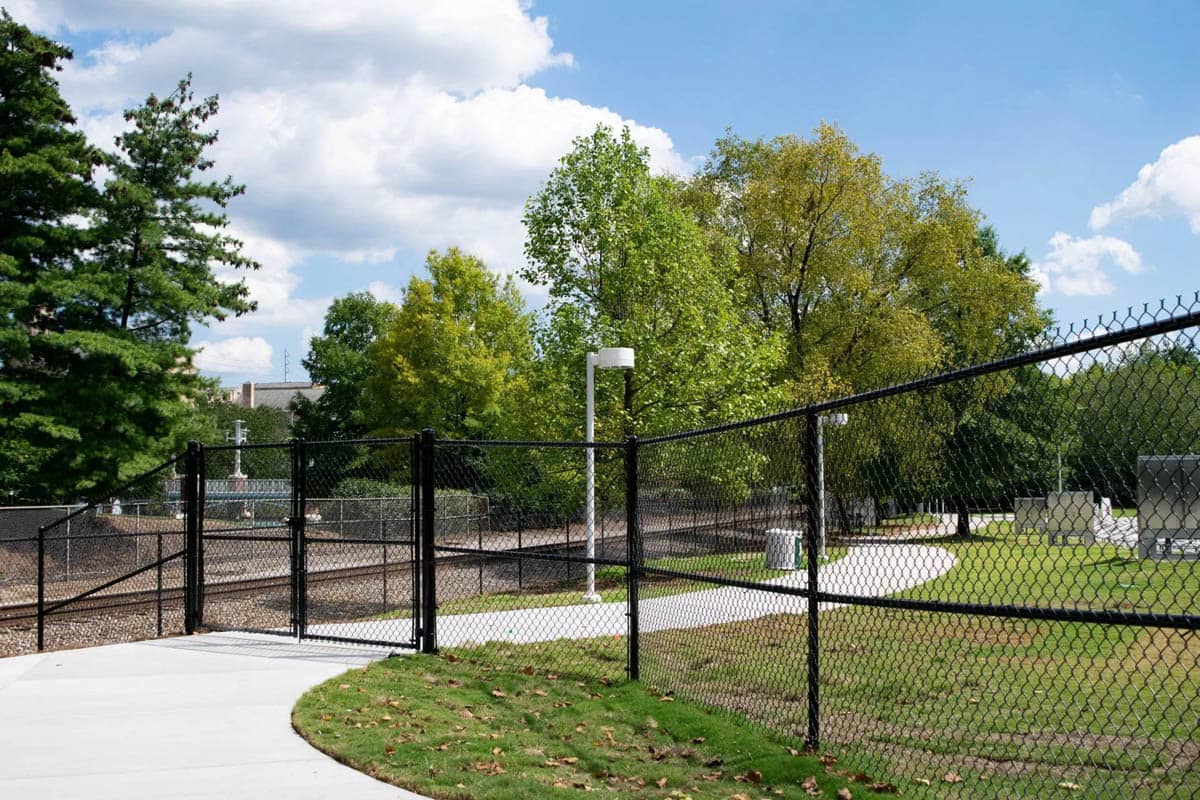
Commercial fencing and industrial security fencing are not the same product. Most fence contractors quote residential and light commercial work. Federal-adjacent, utility and industrial sites are specified against published standards, and the specification drives everything from fabric gauge to footing depth.
Federal and DOE-area sites
UFC 4-022-03, the Unified Facilities Criteria standard for security fences and gates, is widely applied across federal secured sites. It typically calls for 9-gauge fabric or heavier, mesh openings of two inches or less, a minimum seven feet of fabric with eight feet overall including outriggers, 45-degree top guards, three strands of barbed wire, and concrete gate-post footings at least three feet deep.
Nuclear fuel facilities
Fuel facilities are governed by 10 CFR 73.67 rather than the heavier reactor rule. In practice that drives a controlled access area, illumination sufficient for detection and surveillance, intrusion detection at the perimeter, and badge-controlled gates. The governing specification lives in the licensee's approved physical security plan, which is not public — so this work is won through direct coordination with the site's security engineering team, not off a downloadable spec.
Utility, substation and battery storage sites
NEC 110.31 generally requires a seven-foot fence, or six feet plus at least one foot of barbed wire, with the bottom edge no more than two inches above grade. NFPA 855 governs setbacks, barriers and access control at battery energy storage sites. For critical transmission stations, NERC CIP-014 requires a documented physical security plan covering fence height, hardware and buffer distances.
Vehicle barriers
ASTM F2656 rates crash-tested barriers and gates — M50 for a 15,000-pound vehicle at 50 mph, M30 at 30 mph. Anti-ram requirements are common at entry points on secured industrial sites.
Other standards that routinely appear on these submittals include ASTM F2611 (chain link security fencing), F1712 (high-security chain link), F1043 (framework) and F626 (fittings).
Who we work with
On projects of this size we typically work as a subcontractor to the general contractor or construction manager, and directly for facility owners, utilities, municipalities and property managers. Details on our licensing, bonding capacity and insurance limits are on our commercial capabilities page, along with a list of completed projects.
We hold an Unlimited Tennessee Contractor License (#54371), which can be verified through the State of Tennessee license lookup.
Counties we serve
We install commercial, industrial and security fencing across East Tennessee, including Oak Ridge, Anderson County, Roane County, Knox County, Loudon County and Blount County.
Frequently asked questions
Who installs commercial and industrial fencing in Oak Ridge, TN?
Loudon County Fence installs commercial, industrial and security fencing throughout Oak Ridge, Anderson County and Roane County. We are a veteran-owned contractor based in Lenoir City, about 25 miles from Oak Ridge, and have been in business since 1973.
What is the difference between commercial fencing and industrial security fencing?
Commercial fencing generally means perimeter, screening and access control for businesses. Industrial security fencing is specified against published standards such as UFC 4-022-03 or ASTM F2611, and typically involves heavier fabric, taller heights, barbed or anti-climb topping, crash-rated gates and integration with detection and access control systems.
Do you work on federal or DOE-adjacent sites?
Yes. Our commercial work includes projects for the U.S. Department of Energy and the TRISO-X fuel facility in Oak Ridge.
What types of commercial fence do you install?
Heavy-gauge and industrial chain link, ornamental steel and aluminum, automated gates and access control, dumpster and mechanical screening enclosures, substation and equipment yard perimeters, and temporary construction fencing.
How does a general contractor request a bid?
Send your bid package with site plans, specifications, scope and schedule through our quote request page or call (865) 988-9935. Details on bonding and insurance are on our commercial capabilities page.
How long has Loudon County Fence been in business?
Since 1973 — more than 50 years serving East Tennessee.
Building what comes next
Today, billions of dollars in new investment are fueling growth across Oak Ridge, Anderson County, Roane County and East Tennessee. As the region continues to build the future of nuclear technology, we're proud to be here, proud to be local, and proud to help build what comes next.
Commercial fencing. Industrial fencing. Security fencing. Large-scale projects.
To discuss a project, see our commercial capabilities or call (865) 988-9935.
Loudon County Fence. Building more than fences since 1973.